

Boeing 787 Dreamliner
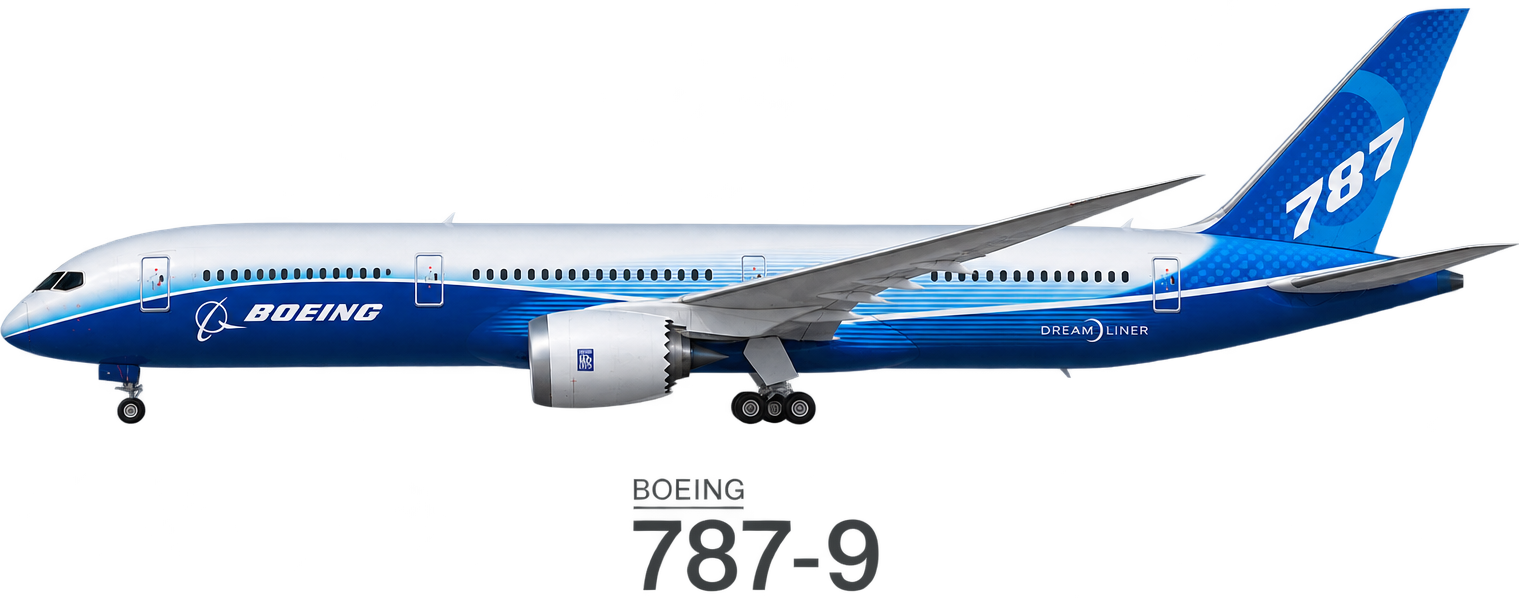 Illustrative image; it may differ from the actual aircraft.
The Boeing 787 Dreamliner, often shortened to Boeing 787, is an American wide-body airliner developed and manufactured by Boeing Commercial Airplanes. After dropping its unconventional Sonic Cruiser project, Boeing announced the conventional 7E7 on January 29, 2003, which focused largely on efficiency. The program was launched on April 26, 2004, with an order for 50 aircraft from All Nippon Airways (ANA), targeting a 2008 introduction. On July 8, 2007, a prototype 787 without major operating systems was rolled out; subsequently the aircraft experienced multiple delays, until its maiden flight on December 15, 2009. Type certification was received in August 2011, and the first 787-8 was delivered in September 2011 and entered commercial service in October 2011, with ANA. At launch, Boeing targeted the 787 with 20% less fuel burn compared to aircraft like the Boeing 767.
Specifications
Figures for the 787-9 variant, the most representative of the family · it is 60% the length of a football pitch
The type first flew in 2009 (17 years ago) · About 1,150 units built · Still in production
Figures for the type, not for this particular aircraft: each variant and each configuration changes something. They are shown in both systems used in aviation.
The story of the type
Development
Background
During the late 1990s, slowing sales of the 767 and 747-400 prompted Boeing to consider replacing them. Two proposals were made: the 747X would have lengthened the 747-400 and improved its efficiency, and the Sonic Cruiser would have achieved 15% higher speeds (approximately Mach 0.98) while burning fuel at the same rate as the 767. Market interest for the 747X proposal was tepid; several major American airlines, including Continental Airlines, showed initial enthusiasm for the Sonic Cruiser, although concerns about its operating cost were expressed. The global airline market was disrupted by the 9/11 attacks and increased petroleum prices, making airlines more interested in efficiency than speed. The worst-affected airlines, those in the United States, had been considered the most likely customers for the Sonic Cruiser; thus the Sonic Cruiser was officially canceled on December 20, 2002. On January 29, 2003, Boeing announced another product, the 7E7, that would use Sonic Cruiser technology in a more conventional configuration. The emphasis on a smaller midsize twinjet rather than a large 747-size aircraft represented a shift from the hub-and-spoke theory toward the point-to-point theory, in response to analysis of focus groups.
Randy Baseler, a vice-president of marketing for Boeing Commercial Airplanes, said that airport congestion comes from large numbers of regional jets and small single-aisle planes, flying to destinations where a 550-seat Airbus A380 would be too large, and that the number of such departures could be reduced by making the smaller airplanes 20% larger and using point-to-point transit to avoid airline hubs.
In 2003, James McNerney, who was then a relatively new member of Boeing's board of directors, supported the idea for a new aircraft to regain market share from Airbus. (In 2005 he took over as CEO.) The 2003 board, which included Harry Stonecipher as CEO as well as John McDonnell, issued an ultimatum to "develop the plane for less than 40 percent of what the 777 had cost to develop 13 years earlier, and build each plane out of the gate for less than 60 percent of the 777's unit costs in 2003", and approved a development budget estimated at US$7 billion as Boeing management claimed that they would "require subcontractors to foot the majority of costs". Boeing Commercial Airplanes president Alan Mulally, who had previously served as general manager of the 777 programs, contrasted the board's approval process for the 787 with that used for the 777, saying "In the old days, you would go to the board and ask for X amount of money, and they'd counter with Y amount of money, and then you'd settle on a number, and that's what you'd use to develop the plane. These days, you go to the board, and they say, 'Here's the budget for this airplane, and we'll be taking this piece of it off the top, and you get what's left; don't fuck up.'"
The project to replace the Sonic Cruiser was named "7E7" (with a development code name of "Y2"). Technology from the Sonic Cruiser and 7E7 was to be used as part of Boeing's project to replace its entire airliner product line, an endeavor called the Yellowstone Project (of which the 7E7 became the first stage). Early concept images of the 7E7 included rakish cockpit windows, a dropped nose, and a distinctive "shark-fin" tail. The "E" was said to stand for various things, such as "efficiency" or "environmentally friendly". In the end, Boeing said it stood for "Eight". In July 2003, a public naming competition was held for the 7E7, for which out of 500,000 votes cast online the winning title was Dreamliner. Other names included eLiner, Global Cruiser, and Stratoclimber.
On April 26, 2004, Japanese airline All Nippon Airways (ANA) became the launch customer for the 787, announcing a firm order for 50 aircraft with deliveries to begin in late 2008. The ANA order was initially specified as 30 787-3, 290–330 seat, one-class domestic aircraft, and 20 787-8, long-haul, 210–250 seat, two-class aircraft for regional international routes such as Tokyo-Narita to Beijing-Capital, and could perform routes to cities not previously served, such as Denver, Moscow, and New Delhi. The 787-3 and 787-8 were to be the initial variants, with the 787-9 entering service in 2010.
On October 5, 2012, Indian state carrier Air India became the first carrier to take possession of a Dreamliner that was manufactured in the Charleston, South Carolina, Boeing plant. This was the first 787 that was manufactured outside of Washington. Boeing would go on to use both the Everett and South Carolina plants to deliver the Dreamliner.
The 787 was the first production airliner built with a fuselage comprising one-piece composite barrel sections instead of aluminum-sheet assemblies using many fasteners. Boeing selected two new engines to power the 787, the Rolls-Royce Trent 1000 and General Electric GEnx.
Variants
The shortest Dreamliner variant, the 787-8 was the first variant to fly in December 2009, then the longer 787-9 in September 2013, followed by the longest variant, the 787-10, in March 2017. These variants are called B788, B789, and B78X, respectively in the list of ICAO aircraft type designators. The short-range 787-3 was canceled in 2010.
With a typical capacity of 248 passengers and a range of 7,305 nautical miles (13,529 km; 8,406 mi), the -8 is the base model of the 787 family and was the first to enter service in 2011. The 787-8 is targeted to replace the Boeing 767-200ER as well as expand into new non-stop markets where larger planes would not be economically viable. As of January 2023, approximately 26% of 787 orders are for the 787-8 with 386 delivered.
In 2018, Boeing said it would change the -8 manufacturing to raise its commonality with the -9 above the current 30% to be more like the 95% commonality between the -9 and -10, as it will benefit from learning from those. When it was launched, a new 787-8 was to cost only slightly more than the 767-300ER, valued new for $85 million at its 1990s peak, but it ended being 20% more costly.
Keeping the same wingspan as the 787-8, the 787-9 is a lengthened and strengthened variant with a 20-foot (6.1 m) longer fuselage and a 54,500-pound (24.7 t) higher maximum take-off weight (MTOW), seating 296 passengers in a typical two-class cabin configuration over a 7,565-nautical-mile (8,706 mi; 14,010 km) range. It features active boundary-layer control on the tail surfaces, reducing drag. The 787-9 is targeted to replace the Boeing 767-300ER. It competes with the Airbus A330-300 and Airbus A330-900.
In 2005, the entry into service (EIS) was planned for 2010. The firm configuration was finalized on July 1, 2010. By October 2011, deliveries were scheduled to begin in 2014.
The prototype 787-9 made its maiden flight from Paine Field on September 17, 2013. By November 8, 2013, it had flown 141 hours. A 787-9 was on static display at the 2014 Farnborough Air Show prior to first delivery. On July 8, 2014, launch customer Air New Zealand took its first 787-9, in a distinctive black livery in a ceremony at Paine Field. The first revenue service was operated by All Nippon Airways on August 7, 2014. Air New Zealand operated its first commercial flight from Auckland to Sydney on August 9, 2014.
The 787-9 was to begin commercial service with All Nippon Airways on August 7, 2014. United Airlines was to start the longest nonstop scheduled 787 service between Los Angeles and Melbourne in October 2014, and the longest California-Australia route in 2026, being San Francisco to Adelaide in 2025. Air China started a 787-9 route between Beijing and Chengdu in May 2016. As of January 2023, 63% of all 787 orders are for the 787-9, with 580 deliveries. A 2014 787-9 leased for $1.05 million per month, and fell to $925,000 per month in 2018.
The 20-foot (6.1 m) stretch was achieved by adding 10-foot (3.0 m) (five-frame) extensions forward and aft of the wing The 787-8 and 787-9 have 50% commonality: the wing, fuselage and systems of the 787-8 had required radical revision to achieve the payload-range goals of the 787-9. Following a major revamp of the original 787-8 wing, the latest configuration for the 787-9 and -10 is the fourth design evolution.
On March 25, 2018, a Qantas 787-9 completed the first scheduled non-stop flight between Australia and the UK flying seventeen hours from Perth to London Heathrow. On October 20, 2019, a Qantas 787-9 was flight tested from New York to Sydney with a restricted payload. A team of researchers monitored passengers and crew to investigate wellness and performance on long flights. On March 16, 2020, an Air Tahiti Nui 787-9 achieved the longest commercial flight of 8,485 nmi (15,714 km; 9,764 mi).
In December 2005, pushed by the interest of Emirates and Qantas, Boeing was studying the possibility of stretching the 787-9 further to seat 290 to 310 passengers. This variant would be similar to the capacity of the Boeing 777-200 and the Airbus A350-900, although with a shorter range. Customer discussions were continuing in early 2006.
Where this type is seen
From our logbook: 152 aircraft of this type documented at 50 airports.
A count of our own aircraft profiles, year by year, from the public United States flight records: it reflects what we have documented, not the airport’s total traffic.
Overview and history adapted from Wikipedia (CC BY-SA) · technical figures from the manufacturer’s published specifications and standard aviation references
Cite
To cite this page in academic work, an article or Wikipedia, choose the style and copy the reference. The access date is today.
This page was last updated on October 10, 2026
APA
Vuelopedia. (2026, October 10). Boeing 787 Dreamliner. Retrieved October 16, 2026, from https://vuelopedia.org/en/model/b787
MLA
“Boeing 787 Dreamliner.” Vuelopedia, Fundación Poderia, 10 Oct. 2026, vuelopedia.org/en/model/b787. Accessed 16 Oct. 2026.
Chicago
Vuelopedia. “Boeing 787 Dreamliner.” Fundación Poderia. Last modified October 10, 2026. https://vuelopedia.org/en/model/b787.
Harvard
Vuelopedia (2026) Boeing 787 Dreamliner. Available at: https://vuelopedia.org/en/model/b787 (Accessed: 16 October 2026).
BibTeX
@misc{vuelopedia_en_model_b787,
  author       = {{Vuelopedia}},
  title        = {{Boeing 787 Dreamliner}},
  publisher    = {Fundación Poderia},
  year         = {2026},
  date         = {2026-10-10},
  url          = {https://vuelopedia.org/en/model/b787},
  howpublished = {\url{https://vuelopedia.org/en/model/b787}},
  urldate      = {2026-10-16},
  note         = {Accessed 2026-10-16}
}Wikipedia
{{cite web |url=https://vuelopedia.org/en/model/b787 |title=Boeing 787 Dreamliner |website=Vuelopedia |publisher=Fundación Poderia |date=2026-10-10 |access-date=2026-10-16 |language=en}}