VUELOPEDIA · THE PEOPLE

The people who made aviation

73people
28pilots
17designers
19countries
1891–2022years covered

An aeroplane is an idea somebody had to defend against the common sense of their own time. This is the timeline of the people who defended it: those who flew first, those who drew the aircraft, those who built the airlines, those who stopped flying from killing people, and those who looked after the cabin. From 1891 to the present day.

Filter by category

The colour says what each of them is known for. Click a category to keep only that one.

The timeline · 73

The ones who made flying possible 1891–1913

From a glider of willow and cloth to an aeroplane that obeys. Not one ticket was on sale yet.

1891 PioneerGermany
Portrait of Otto Lilienthal
Photographer: A. Regis · public domain

Otto Lilienthal 1848–1896

Two thousand glider flights, every one recorded

He understood before anyone that flying is learned by flying. Between 1891 and 1896 he made some two thousand flights in gliders he built himself, and published the lift tables the Wright brothers took as their starting point. He died when one of them stalled.

1903 PioneerUnited States
Portrait of Los hermanos Wright
unattributed · public domain

Los hermanos Wright Wilbur 1867-1912 · Orville 1871-1948

Twelve seconds that split history in two

On 17 December 1903, at Kitty Hawk, the Flyer stayed up for twelve seconds. What mattered was not the engine but control: they invented wing warping to turn, and first built their own wind tunnel because the published figures did not add up. The first flight covered thirty-seven metres; the fourth, two hundred and sixty.

1906 PioneerBrazil
Portrait of Alberto Santos-Dumont
Zaida Ben-Yusuf / Adam Cuerden · public domain

Alberto Santos-Dumont 1873–1932

The 14-bis, and the wristwatch into the bargain

In Paris, before judges and a crowd, he took off under his own power and won the Archdeacon Cup: for half of Europe — and for all of Brazil — that was the first flight. He patented nothing, believing flight should belong to everyone. He asked Cartier for a watch he could read without letting go of the controls, and the wristwatch was born.

1907 PioneerFrance
Portrait of Gabriel Voisin
H. Manny, Bain News Service · public domain

Gabriel Voisin 1880–1973

He opened the world's first aircraft factory

While everyone else was building a machine for themselves, Voisin set up a workshop that sold aircraft to whoever paid for them: the first commercial aircraft manufacturer in history. From it came the biplane in which Henri Farman closed the first one-kilometre circuit, in January 1908.

1909 VisionaryGermany
Portrait of Ferdinand von Zeppelin
Nicola Perscheid · CC BY-SA 3.0

Ferdinand von Zeppelin 1838–1917

The world's first airline came out of his works

DELAG began selling airship tickets in November 1909, five years before the first scheduled aeroplane flight existed. The idea was not his — he opposed it — but Alfred Colsman’s, his works manager, who found both the money and the passengers. It carried more than thirty thousand people without a single fatality, and taught a whole continent that you could buy a ticket to travel through the air.

1909 PioneerFrance
Portrait of Louis Blériot
Unknown authorUnknown author · public domain

Louis Blériot 1872–1936

He crossed the Channel and erased a border

On 25 July 1909 he left Calais in a monoplane from his own workshop and was at Dover a little over half an hour later, with no compass and the engine at its limit. A British paper wrote that England had ceased to be an island. Blériot, bankrupted three times building aircraft, went on to sell hundreds of the Type XI.
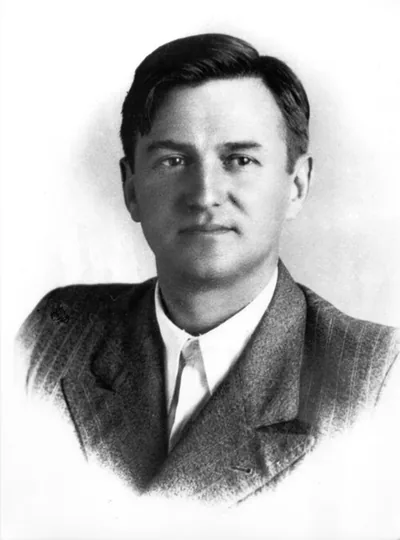
1910 PilotPeru
Portrait of Jorge Chávez
Unknown authorUnknown author · public domain

Jorge Chávez 1887–1910

The first to fly across the Alps

At twenty-three, in a Blériot XI, he flew from Switzerland to Italy through the Simplon Pass — something the experts thought impossible in those winds. He crashed on landing at Domodossola and died four days later. Peru holds him as a national hero and Lima's airport carries his name.

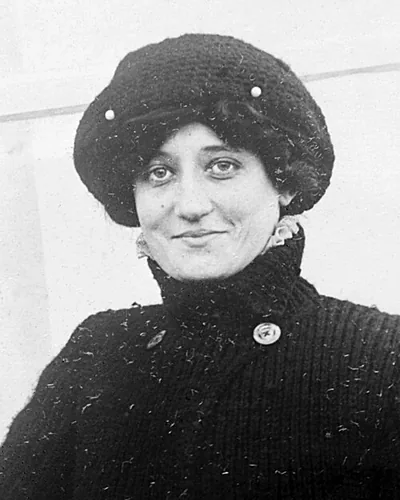
1910 PilotFrance
Portrait of Raymonde de Laroche
Bain News Service, publisher · public domain

Raymonde de Laroche 1882–1919

The first woman in the world with a pilot's licence

On 8 March 1910 she received licence number 36 from the Aéro-Club de France. Nobody before her had had to decide whether that piece of paper could be given to a woman. She survived a crash that same year which left her convalescing for two years, and flew again; she died in 1919 testing a prototype.

1911 PioneerUnited States
Portrait of Glenn Curtiss
Unknown authorUnknown author (Bain News Service). · public domain

Glenn Curtiss 1878–1930

He invented the seaplane and the industry that was missing

A motorcycle builder, he came to the air through engines and stayed for the aircraft. In 1911 he flew the first practical seaplane and opened the door to the clippers that would cross the Pacific thirty years later. His patent war with the Wrights held the American industry back for a full decade.

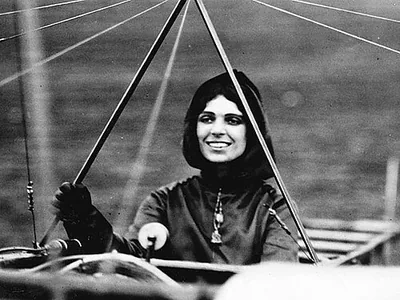
1912 PilotUnited States
Portrait of Harriet Quimby
George Grantham Bain Collection · public domain

Harriet Quimby 1875–1912

She crossed the Channel the day the world was watching the Titanic

A New York journalist, she took her licence in 1911 — the first held by a woman in the United States — and in April 1912 crossed the English Channel alone, through fog and with a borrowed compass. The feat went almost unnoticed: the Titanic had gone down the day before.

The golden age 1914–1938

The first fare is sold, the oceans are crossed, and aviation becomes an industry and a legend at the same time.

1914 PilotUnited States
Portrait of Tony Jannus
public domain

Tony Jannus 1889–1916

He flew the first scheduled passenger service by aeroplane

On 1 January 1914 he took off from St. Petersburg, Florida, with a single passenger who had paid $400 at auction, and landed on the water at Tampa twenty-three minutes later. That line lasted four months and carried 1,205 people, but it is the birth certificate of commercial air transport.

1916 VisionaryUnited States
Portrait of William E. Boeing
Los Angeles Times · CC BY 4.0

William E. Boeing 1881–1956

A timber man who decided to build better aircraft

He inherited forests and sawmills in Seattle, and took two things from them: spruce, and an obsession with the precision of joinery. He founded his company in 1916 after flying as a passenger and deciding he could do better. In 1934 antitrust law split his empire into three.

1919 VisionaryColombia
Portrait of Ernesto Cortissoz
Photograph predating 1924 · public domain

Ernesto Cortissoz 1884–1924

He led the airline from which Avianca comes

A Barranquilla merchant, he presided over SCADTA, founded in December 1919 with Junkers seaplanes to save the eight days of river travel up the Magdalena to Bogotá. From that company comes Avianca, the second-oldest airline still flying. He died in an air crash in 1924.

1919 DesignerGermany
Portrait of Hugo Junkers
Unknown authorUnknown author · CC BY-SA 3.0 de

Hugo Junkers 1859–1935

The first all-metal airliner

The F 13 flew in 1919 with four passengers in an enclosed cabin, seat belts, and a cantilever wing without a single external wire: almost everything that now looks obvious was there for the first time. Junkers came from industrial heating and reached aircraft through thermodynamics. In 1933 his company was taken from him.

1920 DesignerNetherlands
Portrait of Anthony Fokker
Fritz Heuschkel the Elder · public domain

Anthony Fokker 1890–1939

From the German fighter to the European airliner

A Dutchman who built fighters for Germany in the Great War, when it ended he crossed the border with six trainloads of material and set up, near Amsterdam, the factory that gave Europe its first airliners. The F.III carried five passengers inside and the pilot outside, in the open — because that is how the pilots wanted it.

1921 PilotFrance
Portrait of Adrienne Bolland
Unknown. Edited slightly by Daniel Case prior to upload · public domain

Adrienne Bolland 1895–1975

She crossed the Andes in an aircraft that could not climb that high

On 1 April 1921 she left Mendoza in a borrowed Caudron G.3 with no oxygen, no heating and a service ceiling below the mountains, and landed in Chile a little over three hours later. She was twenty-five and had been flying for less than a year.

1921 PilotUnited States
Portrait of Bessie Coleman
National Air and Space Museum · public domain

Bessie Coleman 1892–1926

She went to France because her own country would not have her

No American school would take a Black woman, so she learned French, crossed the Atlantic and in June 1921 earned her international licence at Le Crotoy. She came back as a stunt flier and refused to perform at shows with segregated gates. She died in 1926 testing an aircraft, aged thirty-four.

1923 DesignerSpain
Portrait of Juan de la Cierva
Pascual Marín · public domain

Juan de la Cierva 1895–1936

The articulated rotor, without which there is no helicopter

After one of his own trimotors crashed in a stall, he looked for a machine to which that could not happen, and in January 1923 his C.4 autogyro flew at Getafe. The key was hinging the blades to solve dissymmetry of lift: that is the part every helicopter still carries inside it.

1927 PilotUnited States
Portrait of Charles Lindbergh
Harris & Ewing · public domain

Charles Lindbergh 1902–1974

New York to Paris, non-stop and alone

Thirty-three and a half hours with no co-pilot, no radio and no forward windscreen, because the fuel tank was in front of him. He landed at Le Bourget before a hundred thousand people and returned the first global celebrity. His reputation was later clouded by his politics in the 1930s; the flight, even so, is the one that convinced the world the ocean could be crossed.

1927 VisionaryUnited States
Portrait of Juan Trippe
Unknown authorUnknown author · public domain

Juan Trippe 1899–1981

He invented the intercontinental airline

He began with a mail run to Havana and ended up drawing the network that joined the Americas, the Pacific and Europe. He ordered the aircraft he wanted to exist: Sikorsky's clippers, the 707 and the 747, which he asked for at twice the size Boeing had in mind. He also forced through tourist class, against everyone's advice.

1929 PilotFrance
Portrait of Antoine de Saint-Exupéry
Unknown authorUnknown author · public domain

Antoine de Saint-Exupéry 1900–1944

He wrote exactly what he flew

Station chief at Cape Juby and later a pilot for Aeroposta in Argentina, he opened the Patagonia route and drew from it Night Flight and Wind, Sand and Stars. His books are the best record that exists of what flying the mail was like when flying the mail killed people. He disappeared over the Mediterranean in 1944.

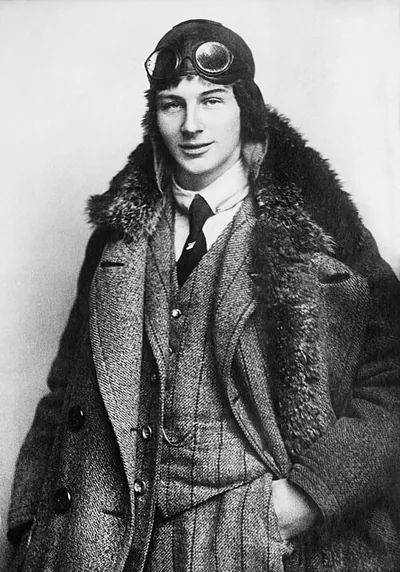
1930 PilotUnited Kingdom
Portrait of Amy Johnson
Andy Dingley (scanner) · public domain

Amy Johnson 1903–1941

London to Australia alone, on eighty hours of flying

A London law-firm secretary, she learned to fly at weekends and in May 1930 left Croydon for Darwin in a second-hand de Havilland Gipsy Moth. Nineteen and a half days later she had done alone what only one man had done before her. She came home the most famous woman in Britain.

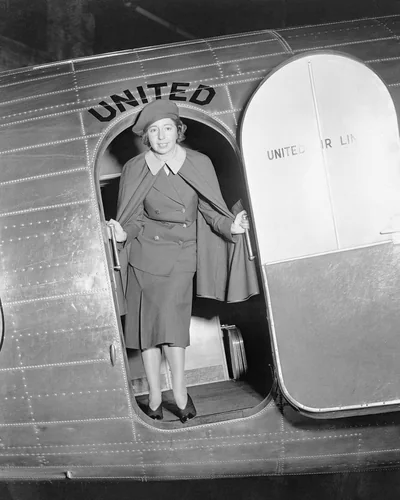
1930 Cabin crewUnited States
Portrait of Ellen Church
United Air Lines · archive photograph

Ellen Church 1904–1965

The first flight attendant in history

A trained nurse and a licensed pilot, she asked to fly for Boeing Air Transport and was turned down. So she proposed something else: put nurses on board, because if they got on, passengers would stop being afraid. On 15 May 1930 she flew Oakland to Chicago with seven others. The profession was born that day.

1930 PilotFrance
Portrait of Jean Mermoz
Unknown authorUnknown author · public domain

Jean Mermoz 1901–1936

He opened the South Atlantic mail

On 12 May 1930 he carried the mailbag from Saint-Louis in Senegal to Natal in a Latécoère seaplane: twenty-one hours over the ocean so that a letter could reach Buenos Aires in four days instead of twenty. He disappeared on that same run in 1936, after radioing that an engine had been shut down.

1931 DesignerUnited States
Portrait of Igor Sikorsky
SDASM Archives · public domain

Igor Sikorsky 1889–1972

The clippers that crossed the oceans

An émigré from Kyiv after the revolution, he started out building on a Long Island farm and ended up making the S-40 and S-42 flying boats with which Pan Am opened the Caribbean and then the Pacific. In 1939 he went back to the idea he had had as a young man — the helicopter — and this time it worked.

1932 PilotUnited States
Portrait of Amelia Earhart
Wide World Photos · public domain

Amelia Earhart 1897 — lost in 1937

Alone across the Atlantic, fifteen hours

In 1928 she had crossed as a passenger and hated being called a heroine for it. On 20 May 1932 she left Newfoundland alone, with a broken altimeter, ice on the wings and a flame coming out of the exhaust manifold, and landed in a field in Northern Ireland. She disappeared over the Pacific in 1937.

1934 SafetyUnited States
Portrait of Elrey Jeppesen
Unknown authorUnknown author · public domain

Elrey Jeppesen 1907–1996

A ten-cent notebook that saved pilots' lives

He flew the night mail and wrote down the height of every hill, the length of every strip and the telephone number of the farmers who told him the weather. His colleagues started asking for copies, and paying for them. From that black notebook comes the approach chart still carried in every cockpit in the world.

1935 DesignerUnited States
Portrait of Donald Douglas
SDASM Archives · no restrictions

Donald Douglas 1892–1981

The DC-3, the aircraft that made passengers pay

His company was born of a TWA specification asking for a trimotor; Douglas delivered a better twin. The DC-3 of 1935 was the first airliner that made money carrying passengers alone, with no subsidised mail behind it. More than ten thousand were built, and a few are still flying.

1935 PilotAustralia
Portrait of Nancy Bird Walton
Russell Roberts (1904–1999) · public domain

Nancy Bird Walton 1915–2009

She took the flying doctor into the Australian outback

At nineteen, with her licence barely in hand, she bought a Gipsy Moth and set up an aerial medical service in western New South Wales, where the nearest hospital was days away. Seventy years later Qantas named Australia's first A380 after her.

1936 VisionaryUnited States
Portrait of C. R. Smith
public domain

C. R. Smith 1899–1990

He ordered the aircraft he wanted over the telephone

A Texan accountant running American Airlines, he called Donald Douglas and asked for a wider DC-2 with sleeping berths, to cross the United States overnight. That call produced the DC-3. He ran the airline for four decades and left it the largest in the country by traffic.

1936 PilotNew Zealand
Portrait of Jean Batten
Sam Hood · public domain

Jean Batten 1909–1982

England to New Zealand, with nobody waiting for her

A New Zealander, she sold her piano to pay for flying lessons. In October 1936 she flew alone from England to Auckland in eleven days, a record that stood for forty-four years. The return trip, Australia to England, took her five days and twenty-one hours.

1938 VisionaryUnited States
Portrait of Howard Hughes
Acme Newspictures · public domain

Howard Hughes 1905–1976

He went round the world in three and a half days

Millionaire, film-maker and record-setting pilot, in July 1938 he circled the planet in 91 hours, less than half the previous record. With TWA in his hands he ordered from Lockheed the Constellation with the pressurised cabin he wanted, and so lifted the transcontinental flight above the weather.

1938 PilotUnited States
Portrait of Willa Brown
Unknown authorUnknown author or not provided · public domain

Willa Brown 1906–1992

She trained the men who trained the Tuskegee airmen

The first African American woman with a commercial pilot's licence in the United States and the first Black officer in the Civil Air Patrol. With Cornelius Coffey she opened a flying school in Chicago for Black students and fought in Washington until the army agreed to take them: instructors for the Tuskegee airmen came out of it.

The jet age 1939–1969

In thirty years it goes from the piston engine to Concorde, and the whole world fits inside a day of travel.

1939 DesignerGermany
Portrait of Hans von Ohain
Air Force Research Laboratory Propulsion Directorate · public domain

Hans von Ohain 1911–1998

The first jet aircraft to fly

A doctoral student at Göttingen, he patented his turbojet in 1936 and talked Ernst Heinkel into building it. The He 178 flew on 27 August 1939, two years before the British engine. Ohain and Whittle arrived at the same thing knowing nothing of each other, and ended up friends.

1941 DesignerUnited Kingdom
Portrait of Frank Whittle
British Government · public domain

Frank Whittle 1907–1996

He patented the turbojet and was told it was no use

An RAF cadet, he patented the jet engine in 1930 at twenty-two; the Air Ministry decided it had no practical value and let the patent lapse. He set up his company on borrowed money and his engine flew in 1941. Rolls-Royce took the design over, and today's turbofans descend from it.

1943 DesignerUnited States
Portrait of Kelly Johnson
CIA · public domain

Kelly Johnson 1910–1990

The Constellation and the triple tail

He joined Lockheed and his first act was to contradict his bosses' wind tunnel: the 1934 Electra was unstable, and he proposed the twin tail. He then signed off the Constellation, pressurised and with three fins so it would fit existing hangars. The Skunk Works came later.

1947 PilotUnited States
Portrait of Chuck Yeager
USAAF official photographer · public domain

Chuck Yeager 1923–2020

He broke the sound barrier with two broken ribs

On 14 October 1947 he went past Mach 1 in the X-1, two days after falling off a horse and telling nobody: he closed the hatch with a broom handle because he could not reach across. The wall everyone thought was physical turned out to be a control problem, and without solving it there would have been neither Comet nor Concorde.

1947 SafetyUnited States
Portrait of Jerome Lederer
NASA · public domain

Jerome Lederer 1902–2004

He turned accidents into a discipline

He inspected air-mail aircraft in 1926 and saw that they were crashing for avoidable reasons. He drove the founding of the Flight Safety Foundation on an idea that was new then: that an accident is studied to prevent the next one, not to apportion blame. Today's safety culture comes from there. He lived to 101.

1947 DesignerSoviet Union
Portrait of Oleg Antónov
Aviation Related People · public domain

Oleg Antónov 1906–1984

Aircraft built to land where there is no airport

The An-2 of 1947, a single-engined biplane, has the longest production run in history: it gets off two hundred metres of grass and shrugs off forty below. The same school produced the An-12 and An-24, and finally the An-124, which carried what nothing else could.

1952 DesignerUnited Kingdom
Portrait of Geoffrey de Havilland
SDASM Archives · public domain

Geoffrey de Havilland 1882–1965

The Comet, the first jet airliner

On 2 May 1952 a BOAC Comet left London for Johannesburg with fare-paying passengers: the world entered the jet age four years early. Two years later metal fatigue tore two Comets apart in flight. The investigations were published in full, and from them the industry learned how to design everyone else's fuselage.

1953 DesignerUnited Kingdom
Portrait of George Edwards
AI recreation

George Edwards 1908–2003

The Viscount, the first turboprop airliner

Under his direction Vickers put into service, in 1953, the world's first turbine-powered airliner. The Viscount sold even in the United States and beat the piston twins for a reason passengers noticed before the airlines did: it did not vibrate. He later ran the British side of Concorde.

1953 PilotFrance
Portrait of Jacqueline Auriol
André Cros · CC BY-SA 4.0

Jacqueline Auriol 1917–2000

A test pilot with a rebuilt face

A crash in 1949 destroyed her face and took more than twenty operations to repair. She flew again before they were finished, became a French state test pilot and set five world speed records through the fifties and sixties, testing what others would not.

1953 PilotUnited States
Portrait of Jacqueline Cochran
Unknown authorUnknown author or not provided · public domain

Jacqueline Cochran 1906–1980

The first woman to pass Mach 1

Raised in poverty in the Florida panhandle, she built a cosmetics business and took her licence to sell it better. She ended up leading the WASP during the war and, in 1953, going supersonic with Chuck Yeager flying chase. When she died she held more speed, distance and altitude records than any other pilot, man or woman.

1954 VisionaryUnited States
Portrait of Bill Allen
SDASM Archives · public domain

Bill Allen 1900–1985

He bet the whole company on one prototype

A lawyer with no engineering training, he spent the equivalent of a quarter of Boeing's net worth building an aircraft nobody had ordered: the Dash 80, which flew in 1954. From it came the 707 and the tanker that paid for everything. Had he been wrong, there would be no Boeing.

1955 PilotUnited States
Portrait of Tex Johnston
AI recreation

Tex Johnston 1914–1998

He barrel-rolled the prototype of the 707

On 7 August 1955, over Lake Washington and in front of the presidents of nearly every airline in the country, he rolled the Dash 80 twice. Bill Allen thought he was watching the company end. The next day Johnston explained that a properly flown barrel roll is a one-G manoeuvre and the aircraft had felt nothing.

1956 DesignerSoviet Union
Portrait of Andréi Túpolev
Letectví (neznámý, unknown) · public domain

Andréi Túpolev 1888–1972

Two years with the only jet airliner in service

He designed more than a hundred aircraft and spent four years in one of Stalin's prison design bureaux, where he kept working. His Tu-104 entered service in 1956 and for two years was the only jet airliner flying daily anywhere in the world, while the Comet sat on the ground.

1958 SafetyAustralia
Portrait of David Warren
Uploaded first to de.wikipedia: 18:30, 27. Apr 2004 . . Avatar (Diskussion) . . 600 x 593 · public domain

David Warren 1925–2010

He invented the black box, and his own country turned it down

His father died in an air crash when he was nine. Investigating another in 1953 he reasoned that if the cockpit voices were recorded you would know what had happened, and by 1958 he had a prototype. Australia dismissed it for five years and it was Britain that adopted it. Today it is mandatory everywhere.

1958 Cabin crewUnited States
Portrait of Ruth Carol Taylor
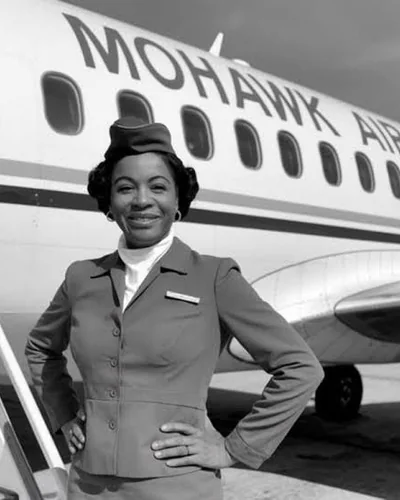
Mohawk Airlines · archive photograph

Ruth Carol Taylor 1931–2023

The first Black flight attendant in the United States

A New York nurse, she was turned down by a major carrier and hired by Mohawk Airlines after a public campaign. She flew for the first time in February 1958 and was dismissed six months later: airlines then barred married flight attendants. She spent the rest of her life on civil rights.

1963 DesignerSoviet Union
Portrait of Serguéi Ilyushin
Unknown authorUnknown author · public domain

Serguéi Ilyushin 1894–1977

The aircraft that put half the world in the air

His Il-18 turboprop of 1959 carried Soviet domestic traffic for decades, and the Il-62 of 1963 — four engines on the tail and a extra leg under the fuselage to stop it sitting back — linked Moscow with Havana and New York. He designed for dirt strips and for mechanics with no workshop.

1968 PilotNorway
Portrait of Turi Widerøe
Unknown authorUnknown author · public domain

Turi Widerøe b. 1937

The first woman at the controls of a major airline

She qualified as a captain in 1968 at Widerøe, the airline her father had founded, flying floatplanes along the Norwegian coast. That same autumn SAS took her on as a Convair 440 first officer: the first woman at the controls at a major Western carrier. The airline received letters from passengers asking not to fly with her. Years later she left the cockpit for publishing and history.

1969 PilotFrance
Portrait of André Turcat
André Cros · CC BY-SA 4.0

André Turcat 1921–2016

He lifted Concorde off the ground for the first time

On 2 March 1969 he took prototype 001 off from Toulouse and landed under half an hour later with a sober sentence: the great bird flies at last. He was an engineer as well as a test pilot, and the following year he took the aircraft to Mach 2.

1969 PilotUnited Kingdom
Portrait of Brian Trubshaw
André Cros · CC BY-SA 4.0

Brian Trubshaw 1924–2001

The other Concorde, the one from Filton

He flew the British prototype 002 on 9 April 1969, five weeks after Turcat, and landed with both radio altimeters failed, by eye. The two teams shared everything through ten years of testing: it is the first airliner developed by two countries under a treaty.

1969 DesignerUnited States
Portrait of Joe Sutter
Darko.veberic · CC0

Joe Sutter 1921–2016

The 747, drawn in twenty-eight months

They gave him a team they called the Incredibles and an impossible deadline, because the 747 was conceived as a stopgap freighter until the supersonic arrived. He put in two aisles instead of two decks and lifted the flight deck to leave the nose clear: that is where the hump comes from. It flew forty years longer than planned.

1969 VisionaryBrazil
Portrait of Ozires Silva
José Cruz/ABr · CC BY 3.0 br

Ozires Silva b. 1931

He founded Embraer with one aircraft and a country to persuade

A Brazilian Air Force engineer, he pushed for years a project for a twin built for the distances of the interior. Embraer was born on 19 August 1969 and the Bandeirante entered service in 1973. Half a century later Brazil is the world's third builder of airliners.

Flying for everyone 1970–1999

The aeroplane stops being a luxury: the wide body arrives, then low cost, then the first women in command.

1970 VisionaryFrance
Portrait of Henri Ziegler
André Cros · CC BY-SA 4.0

Henri Ziegler 1906–1998

He built a consortium that was not supposed to work

He had run Breguet and Sud Aviation, and became the first managing director of Airbus Industrie, formally constituted on 18 December 1970, a year and a half after France and West Germany struck their agreement. His achievement was not technical but political: getting the French, Germans, British and Spanish to end up sharing an assembly line without any of them being wholly in charge.

1971 VisionaryUnited States
Portrait of Herb Kelleher
SouthwestArchive · CC BY-SA 4.0

Herb Kelleher 1931–2019

He turned cheap flying into a serious business

He sketched the idea on a napkin and spent four years in court before he could take off, in June 1971, with three aircraft and three Texas cities. One aircraft type, ten-minute turnarounds and no assigned seats: that is the low-cost manual half of Europe and half of Asia later copied.

1972 VisionaryFrance
Portrait of Roger Béteille
Photo aerospatiale (dont les noms des photographes sont anonymes), reprise par EADS-Airbus · CC BY-SA 3.0

Roger Béteille 1921–2019

He decided what the first Airbus had to be

An engineer and test pilot, he chose the wide-body short-haul twin nobody was building and rejected what everyone was asking for. He also forced through two ideas now common to the whole industry: a common cockpit across models, and selling aircraft that do not yet exist. The A300 flew in 1972.

1973 PilotUnited States
Portrait of Emily Howell Warner
AI recreation

Emily Howell Warner 1939–2020

The first female US airline pilot in forty years

She applied to the same airline for eight years running. In January 1973 they hired her: the first woman to fly for a US airline since 1934. Three years later she was a captain, and her uniform ended up in the Smithsonian.

1974 SafetyUnited States
Portrait of Wally Funk
NASA · public domain

Wally Funk 1939–2026

The NTSB's first female accident investigator

A flight instructor at twenty, she became the FAA's first female inspector in 1971 and, in 1974, the NTSB's first female air safety investigator: the only woman in the rooms where it was decided why an aircraft had come down. In 2021, at eighty-two, she finally went to space.

1977 VisionaryUnited Kingdom
Portrait of Freddie Laker
AI recreation

Freddie Laker 1922–2006

The first transatlantic flight with no reservation

Skytrain left Gatwick for New York on 26 September 1977 after six years of litigation: you bought the ticket the same day, at a counter, for a third of the price. The major carriers cut fares until he collapsed in 1982, and years later a US court found in his favour.

1984 VisionaryUnited Kingdom
Portrait of Richard Branson
User:David Shankbone · CC BY 3.0

Richard Branson b. 1950

An airline with one leased aircraft

He started Virgin Atlantic in 1984 with a second-hand 747 and one route to New York, convinced you could take on British Airways by selling something else: massage seats, ice cream during the film, and a great deal of noise. He survived two decades of trench warfare over the North Atlantic.

1986 PilotUnited States
Portrait of Beverley Bass
AI recreation

Beverley Bass

American's first female captain, and the day of Gander

She joined American Airlines in 1976 and in 1986 became its first woman in command. On 11 September 2001 she diverted her flight to Gander, Newfoundland, along with thirty-seven other aircraft: that town housed almost seven thousand passengers for five days. The story is now a Broadway musical.

1986 DesignerUnited States
Portrait of Burt Rutan
Steve Paluch · CC BY-SA 3.0

Burt Rutan b. 1943

Round the world non-stop and without refuelling

He designed Voyager in composites, with two engines in line and almost the entire aircraft turned into a fuel tank. On 23 December 1986 it came back to California nine days after leaving, with the tanks all but dry. No aircraft had ever done it, and nobody has done it quite that way since.

1986 PilotUnited States
Portrait of Jeana Yeager
Ray Kamm, SDASM Archives · no restrictions

Jeana Yeager b. 1952

Nine days shut inside a two-metre cabin

She flew Voyager with Dick Rutan in a space the size of a telephone box laid on its side, taking turns to sleep. The aircraft was so heavy on take-off that the wingtips dragged along the runway and broke off. She was the first woman to fly round the world non-stop.

1986 Cabin crewIndia
Portrait of Neerja Bhanot
India Post, Government of India · GODL-India

Neerja Bhanot 1963–1986

She hid the passports and opened the door

A Pan Am purser at twenty-two, during the hijacking of Flight 73 in Karachi she hid the American passports so nobody could be singled out, and opened an emergency exit. She died shielding three children. India created an award in her name and the cinema later told her story.

1988 DesignerFrance
Portrait of Bernard Ziegler
André Cros · CC BY-SA 4.0

Bernard Ziegler 1933–2021

The sidestick and the flight envelope protections

A test pilot and the son of Henri Ziegler, he brought to the 1988 A320 electrical controls, the sidestick, and protections that stop the aircraft leaving its envelope even if the pilot asks it to. It was fiercely argued over, inside the company and out. Today practically everything built has it.

Our own time from 2000

A mature industry arguing about its price, its footprint and who gets to build it. And now and then, a flight nobody forgets.

2004 VisionaryIreland
Portrait of Michael O'Leary
World Travel & Tourism Council · CC BY 2.0

Michael O'Leary b. 1961

He took low cost down to the last cent

An accountant by training, he copied the Southwest model and pushed it further than anyone: one aircraft family, secondary airports, and a charge for everything that is not the seat. Ryanair now carries more passengers than any other European airline. He is also the most argued-over executive in the industry, and makes no secret of it.

2008 VisionaryUnited Arab Emirates
Portrait of Tim Clark
AI recreation

Tim Clark b. 1949

He kept the A380 alive when nobody else wanted it

He arrived in Dubai in 1985 to set up an airline with two leased aircraft. Running Emirates, he ordered 123 A380s — almost half of all those ever built — and constructed a network that uses the Gulf as a bridge between Europe and Asia. Without him that aircraft would have lasted half as long.

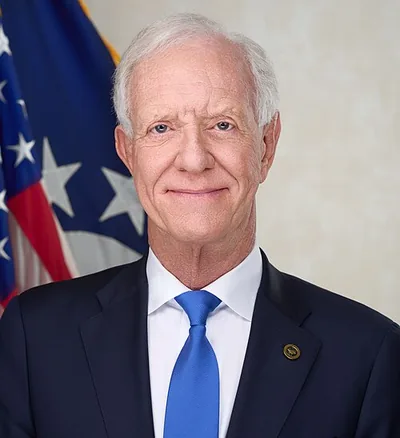
2009 PilotUnited States
Portrait of Chesley Sullenberger
United States Department of State · public domain

Chesley Sullenberger b. 1951

Two hundred and eight seconds and a river

On 15 January 2009 his A320 lost both engines to a flock of geese below a thousand metres. He ruled out returning to LaGuardia, ruled out Teterboro, and landed on the Hudson: a hundred and fifty-five people, no fatalities. The case changed the checklists and the way a low-altitude dual engine failure is trained.

2010 PilotAustralia
Portrait of Richard de Crespigny
Mosman library · CC BY 2.0

Richard de Crespigny b. 1957

The A380 that came back with the screens full of warnings

On 4 November 2010 an engine on flight QF32 burst over Indonesia, cutting cables, tanks and systems. The crew — five pilots aboard by chance — took almost two hours to make sense of it and landed at Singapore with all 469 people unharmed. It is the case studied for when the computer stops helping.

2016 PilotSwitzerland
Portrait of Bertrand Piccard
COP PARIS · CC0

Bertrand Piccard b. 1958

Round the world without a drop of fuel

A psychiatrist and balloonist, he flew round the world by balloon in 1999 and then set out to do it on sunlight. Solar Impulse 2 completed the circuit in 2016 over seventeen legs shared with André Borschberg, one of them five days straight across the Pacific. It was not a transport aircraft: it was a demonstration, and it worked.

2017 DesignerChina
Portrait of Wu Guanghui
AI recreation

Wu Guanghui b. 1960

The C919, the third player

Chief designer of the C919, the first Chinese aircraft to take on the A320 and the 737 — the largest segment of the market — after his own company’s regional ARJ21. It flew at Shanghai on 5 May 2017 and entered service in 2023. For the first time in half a century, the Airbus-Boeing duopoly has a third name in front of it.

2022 PilotBelgium
Portrait of Zara Rutherford
AI recreation

Zara Rutherford b. 2002

The youngest round-the-world flight, in a microlight

At nineteen she flew round the world alone in a microlight: five months, fifty thousand kilometres, five continents and a month stuck in Alaska waiting for the weather. She did it, she said, so girls would see someone their own age in the cockpit: barely 5% of the world's airline pilots are women.

Who is here, and why

This is an encyclopedia of CIVIL aviation, and that is the test: you are here if you changed the aviation that carries passengers, freight or mail.

That is why there are pioneers who died before an air ticket existed — without Lilienthal and the Wrights there is none of the rest — and why there are no fighter aces. The few names of military origin are here for what their work made possible afterwards: without Yeager's flight of 1947 there would have been neither Comet nor Concorde.

The year that orders the timeline is the year of the deed each person is here for, not the year they were born: that is why Joe Sutter appears in 1969 with the 747 and not in 1921. And when the story grows out of a tragedy it is told by what it left behind — the black box, metal fatigue, a new checklist — with the same restraint as in On This Day: no casualty figures and no hook.

Sources and photographs

Birth and death dates come from Wikidata and can be checked through the link on each entry. The facts are told by us from public sources; where something could not be confirmed, it is not published.

Most portraits come from Wikimedia Commons, and of those only freely licensed ones are shown, with author and licence under the image; three are archive photographs supplied by the editors. Another eight are recreations made with artificial intelligence and carry that warning beneath the portrait: they are illustrations of how that person looked in their day, not photographic documents, and should not be cited as such. Under every image we say where it came from.

Cite

To cite this page in academic work, an article or Wikipedia, choose the style and copy the reference. The access date is today.

This page was last updated on September 30, 2026

APA

Vuelopedia. (2026, September 30). The people who made aviation. Retrieved October 16, 2026, from https://vuelopedia.org/en/people

MLA

“The people who made aviation.” Vuelopedia, Fundación Poderia, 30 Sept. 2026, vuelopedia.org/en/people. Accessed 16 Oct. 2026.

Chicago

Vuelopedia. “The people who made aviation.” Fundación Poderia. Last modified September 30, 2026. https://vuelopedia.org/en/people.

Harvard

Vuelopedia (2026) The people who made aviation. Available at: https://vuelopedia.org/en/people (Accessed: 16 October 2026).

BibTeX

@misc{vuelopedia_en_people,
  author       = {{Vuelopedia}},
  title        = {{The people who made aviation}},
  publisher    = {Fundación Poderia},
  year         = {2026},
  date         = {2026-09-30},
  url          = {https://vuelopedia.org/en/people},
  howpublished = {\url{https://vuelopedia.org/en/people}},
  urldate      = {2026-10-16},
  note         = {Accessed 2026-10-16}
}

Wikipedia

{{cite web |url=https://vuelopedia.org/en/people |title=The people who made aviation |website=Vuelopedia |publisher=Fundación Poderia |date=2026-09-30 |access-date=2026-10-16 |language=en}}

Explore the encyclopedia