

Los Angeles International Airport
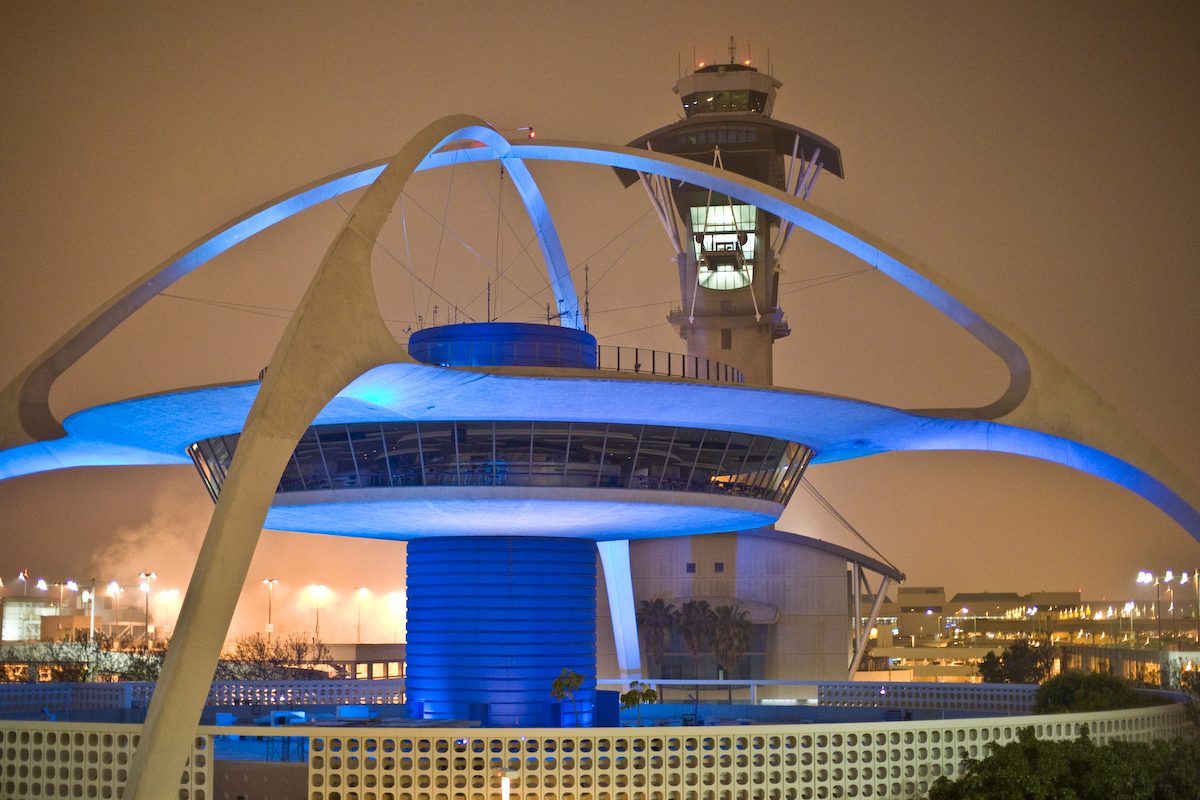
Los Angeles International Airport
Los Angeles International Airport (IATA: LAX, ICAO: KLAX, FAA LID: LAX) is the primary international airport serving Los Angeles and its surrounding metropolitan area, in the U.S. state of California. LAX is located in the Westchester neighborhood of the City of Los Angeles, 18 miles (29 km; 16 nmi) southwest of downtown Los Angeles, with the commercial and residential areas of Westchester to the north, the city of El Segundo to the south, and the city of Inglewood to the east. LAX is the closest airport to the Westside and the South Bay. The airport is operated by Los Angeles World Airports (LAWA), a branch of the Los Angeles city government, that also operates the Van Nuys Airport for general aviation. The airport covers 3,500 acres (1,400 ha) of land and has four parallel runways. In 2023, LAX handled 75,050,875 passengers, making it the world's eleventh-busiest airport, according to the Airports Council International rankings. In 2024, LAX served 76,587,980 passengers, a 2.04% increase from 2023. As the largest and busiest international airport on the West Coast of the United States, LAX is a major international gateway for the country, serving as a connection point for passengers traveling internationally (such as East and Southeast Asia, Australasia, Mexico, and Central America).
Location

33.943°N, 118.408°O · 38 m s. n. m. (125 ft)
General data
Runways · 4
Lengths and surfaces from the public OurAirports register; open runways only.
Radio frequencies · 6
Tower
Ground
Clearance delivery
ATIS (automatic information)
Approach
UNICOM
Reference frequencies for enthusiasts, from OurAirports (community database, public domain), checked on Oct 16, 2026. They may be outdated or incomplete and do not replace the AIP or current charts: not for navigation. In Europe the published frequency may be an 8.33 kHz channel (e.g., 118.505 for 118.500). In MHz.
History
In 1926, the Los Angeles City Council and the Chamber of Commerce recognized the need for the city to have its own airport to tap into the fledgling, but quickly growing, aviation industry. Several locations were considered, but the final choice was a 640-acre (1 sq mi; 259 ha) field in the southern part of Westchester. The location had been promoted by real estate agent William W. Mines, and Mines Field as it was known had already been selected to host the 1928 National Air Races. On August 13, 1928 the city leased the land and the newly formed Department of Airports began converting the fields, once used to grow wheat, barley, and lima beans, into dirt landing strips.
The airport opened on October 1, 1928 and the first structure, Hangar No. 1, was erected in 1929. The building still stands at the airport, remaining in active use and listed on the National Register of Historic Places. Over the next year, the airport started to come together: the dirt runway was replaced with an all-weather surface and more hangars, a restaurant, and a control tower were built. On June 7, 1930, the facility was dedicated and renamed Los Angeles Municipal Airport.
The airport was used by private pilots and flying schools, but the city’s vision was that Los Angeles would become the main passenger hub for the area. However, the airport failed to entice any carriers away from the established Burbank Airport or the Grand Central Airport in Glendale.
World War II put a pause on any further development of the airport for passenger use. Before the United States entered the war, the aviation manufacturers located around the airport were busy providing aircraft for the Allied powers, while the flying schools found themselves in high demand. In January 1942, the military assumed control of the airport, stationing fighter planes there, and building naval gun batteries in the ocean dunes to the west.
Meanwhile, airport managers published a master plan for the land and, in early 1943, convinced voters to back a $12.5 million bond for airport improvements. With a plan and funding in place, the airlines were finally convinced to make the move.
After the end of the war, four temporary terminals were quickly erected on the north side of the airport and, on December 9, 1946, American Airlines, Trans World Airlines (TWA), United Airlines, Southwest Airways, and Western Airlines began passenger operations at the airport, with Pan American Airways (Pan Am) joining the next month. The airport was renamed Los Angeles International Airport in 1949.
The temporary terminals remained in place for 15 years but quickly became inadequate, especially as air travel entered the "jet age" and other cities invested in modern facilities. Airport leaders once again convinced voters to back a $59 million bond on June 5, 1956.
The current layout of the passenger facilities was established in 1958 with a plan to build a series of terminals and parking facilities, arranged in the shape of the letter U, in the central portion of the property. The original plan called for the terminal buildings to be connected at the center of the property by a huge steel-and-glass dome. The dome was never built, but a smaller Theme Building, constructed in the central area, became a focal point for people coming to the airport. The structure was dedicated on June 25, 1961, by Vice President Lyndon B. Johnson.
The first of the new passenger buildings, Terminals 7 and 8, were opened for United Airlines on June 25, 1961, following opening festivities that lasted several days. Terminals 2, 3, 4, 5, and 6 opened later that same year.
There was a major expansion of the airport in the early 1980s, ahead of the 1984 Summer Olympic Games. In November 1983, a second-level roadway was added, Terminal 1 opened in January 1984 and the Tom Bradley International Terminal opened in June 1984. The original terminals also received expansions and updates in the 1980s.
Since 2008, the airport has been undergoing another major expansion. All of the terminals are being refurbished, and the Tom Bradley International Terminal was substantially rebuilt, with a West Gates satellite concourse added. Outside of the terminal area, the LAX West Intermodal Transportation Facility with 4,300 parking spaces opened in 2021, replacing the former Lot C. A new LAX/Metro Transit Center and an LAX Rental Car Center (RCC) were built. All will be connected to the terminal area by SkyLink. Altogether, those projects are expected to cost $30 billion and bring LAX's total gates from 146 to 182. Ultra low-cost carriers say project costs have made operations at LAX unsustainable under their low-fare model, with fees hitting around $50 per departing passenger. As a result, Allegiant Air is shutting its LAX crew base and cutting several routes.
The "X" in LAX
Before the 1930s, US airports used a two-letter abbreviation and "LA" served as the designation for Los Angeles Airport. In 1947, with rapid growth in the aviation industry, the identifiers were expanded to three letters, and "LA" received an extra letter to become "LAX". The "X" does not have any specific meaning.
What flies here
From our own logbook: 6,452 aircraft documented between 2006 and 2025.
Types seen here
 Boeing 7372,039
 Airbus A321766
 Boeing 737 MAX643
 Airbus A320554
 Boeing 757298
 Embraer E170 / E175276
 Bombardier CRJ250
 Airbus A319240
 Boeing 767189
 Boeing 777181
Airlines with documented aircraft
Busiest routes from here
A count of our own aircraft profiles, year by year, from the public United States flight records: it reflects what we have documented, not the airport’s total traffic.
Airlines operating here · 76
Other airlines with direct routes
Airlines with current passenger routes from here, according to Wikipedia route tables cross-checked from both ends (October 2026).
Photo: monkeytime | brachiator · CC BY-SA 2.0 · view original
Data from OurAirports (public domain) · destinations and airlines from Wikipedia route tables (CC BY-SA, 2026), unless another source is given · profile and photo from Wikidata/Wikimedia Commons (CC0 / CC) · summary and history from Wikipedia (CC BY-SA).
Cite
To cite this page in academic work, an article or Wikipedia, choose the style and copy the reference. The access date is today.
This page was last updated on October 15, 2026
APA
Vuelopedia. (2026, October 15). Los Angeles International Airport (LAX). Retrieved October 16, 2026, from https://vuelopedia.org/en/airport/LAX
MLA
“Los Angeles International Airport (LAX).” Vuelopedia, Fundación Poderia, 15 Oct. 2026, vuelopedia.org/en/airport/LAX. Accessed 16 Oct. 2026.
Chicago
Vuelopedia. “Los Angeles International Airport (LAX).” Fundación Poderia. Last modified October 15, 2026. https://vuelopedia.org/en/airport/LAX.
Harvard
Vuelopedia (2026) Los Angeles International Airport (LAX). Available at: https://vuelopedia.org/en/airport/LAX (Accessed: 16 October 2026).
BibTeX
@misc{vuelopedia_en_airport_lax,
  author       = {{Vuelopedia}},
  title        = {{Los Angeles International Airport (LAX)}},
  publisher    = {Fundación Poderia},
  year         = {2026},
  date         = {2026-10-15},
  url          = {https://vuelopedia.org/en/airport/LAX},
  howpublished = {\url{https://vuelopedia.org/en/airport/LAX}},
  urldate      = {2026-10-16},
  note         = {Accessed 2026-10-16}
}Wikipedia
{{cite web |url=https://vuelopedia.org/en/airport/LAX |title=Los Angeles International Airport (LAX) |website=Vuelopedia |publisher=Fundación Poderia |date=2026-10-15 |access-date=2026-10-16 |language=en}}