

Louis Armstrong New Orleans International Airport
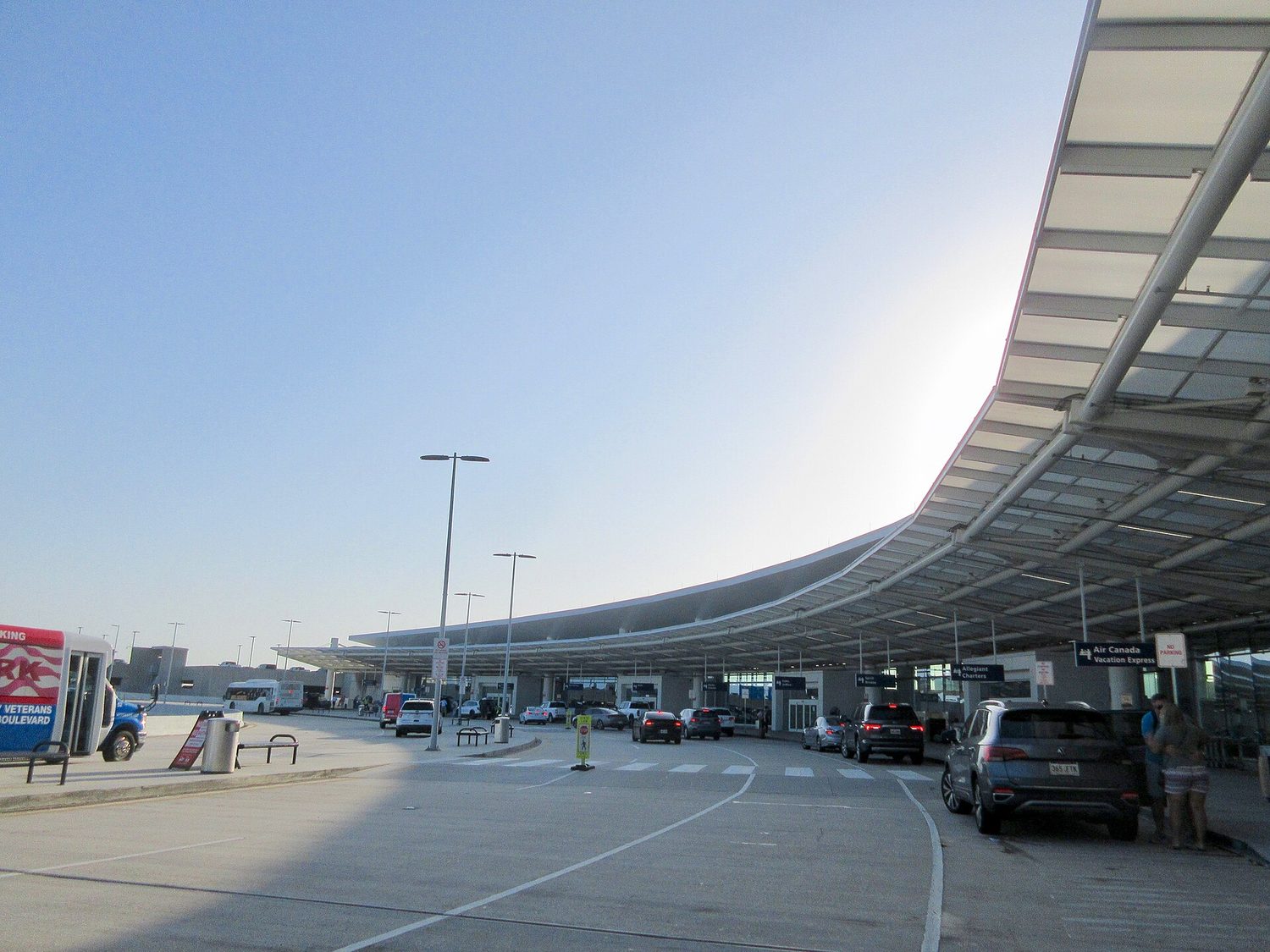
Louis Armstrong New Orleans International Airport
Louis Armstrong New Orleans International Airport (IATA: MSY, ICAO: KMSY, FAA LID: MSY) is an international airport under Class B airspace in the City of Kenner, Jefferson Parish, Louisiana, United States. It is owned by the City of New Orleans and is 11 miles (18 km) west of downtown New Orleans. A small portion of Runway 11/29 is in unincorporated St. Charles Parish. Armstrong International is the primary commercial airport for the New Orleans metropolitan area and southeast Louisiana. Nonstop service to some sixty destinations is provided, including flights to Europe, Canada, Latin America and the Caribbean. MSY covers 1,500 acres (607 ha) of land and contains two runways and two helipads. At an average of 4.5 feet (1.4 m) above sea level, MSY is the third lowest-lying international airport in the world, behind only Amsterdam Airport Schiphol in the Netherlands, which is 11 feet (3.4 m) below sea level, and Atyrau International Airport in Kazakhstan, which lies 72 feet (22 m) below sea level.
Location

29.993°N, 90.265°O · 1 m s. n. m. (4 ft)
General data
Runways · 2
Lengths and surfaces from the public OurAirports register; open runways only.
Radio frequencies · 8 Official publication
Tower
Ground
Clearance delivery
ATIS (automatic information)
Approach
UNICOM
Frequencies from the official publication: FAA NASR, AIRAC 01 OCT 2026, checked on Oct 16, 2026. They change with each amendment: not for navigation without checking the current AIP. See the official publication In MHz.
History
In the early 20th century, the location hosted agricultural fields. On Dec. 31, 1910, daredevil aviator John Moisant, died in 1910 in an airplane accident when he was thrown from his plane. The area was shortly after converted to a stockyard and was named Moisant Stock Yards after him. The airport's IATA code, MSY, is derived from this name. Plans for a new airport began in 1940, as evidence mounted that the older New Orleans Lakefront Airport was too small. It was originally named Moisant Field. In World War II the land became a government air base. It returned to civil control after the war and commercial service commenced in May 1946. When commercial service began at Moisant Field in 1946, the terminal occupied a large, makeshift hangar-like building. In September 1947, the airport was shut down as it was submerged under two feet of water in the wake of the 1947 Fort Lauderdale Hurricane's impact. A new terminal complex debuted in 1959 towards the end of Mayor DeLesseps "Chep" Morrison's administration. This structure, greatly expanded in the 1970s and the recipient of two rebuilt concourses in the 1990s and 2000s, comprised the passenger terminal until its replacement in November 2019. The former terminal contained two sections, East and West, connected by a central ticketing alley and baggage claim. Four concourses, A, B, C and D, were attached to the terminal, which eventually grew to a total of 47 gates. The vaulted arrivals lounge at the head of Concourse C and the adjacent, western half of the ticketing alley are the remaining portions of the airport's 1959 terminal complex. Retired United States Air Force Major General Junius Wallace Jones served as airport director in the 1950s. During his term, a period of rapid change in civil aviation, the airport received many improvements. By the time the airport's 1959 terminal building opened, the name Moisant International Airport was being used for the New Orleans facility. In 1961, the name was changed to New Orleans International Airport. The airport's mid-1970s expansion included a lengthened main terminal ticketing area, an airport access road linking the terminal to Interstate 10, and the construction of Concourses A and B. The two original 1959 concourses were renamed Concourse C and Concourse D, with the latter receiving a four-gate addition at its terminus, designed to accommodate widebody aircraft. In July 1978, National Airlines began flights to Amsterdam with continuing same-plane service to Frankfurt utilizing widebody McDonnell Douglas DC-10s. This was New Orleans' first nonstop transatlantic flight. Less than a month later, National added a stop in Tampa due to low demand. In May 1981, British Airways inaugurated a flight from London's Gatwick Airport to Mexico City that stopped in New Orleans. It flew a Lockheed L-1011 TriStar on the route. The airline, then government-owned, discontinued the service in October 1982 because of its deepening financial problems. Northeastern International Airways operated a small hub at MSY in the spring of 1984. Another airline that attempted to operate a hub at MSY was short-lived Pride Air which was based in New Orleans and was operating nonstop or direct Boeing 727 service from the airport to sixteen destinations, including cities in California, Florida, and the western U.S., in the summer of 1985. In July 2001, to honor the 100th anniversary of Louis Armstrong's birth (August 4, 1901), the airport's name became Louis Armstrong New Orleans International Airport. MSY reopened to commercial flights on September 13, 2005, after the devastation of Hurricane Katrina the previous month, with four flights operated by Delta Air Lines to Atlanta and a Northwest Airlines flight to Memphis. Slowly, service from other carriers began to resume. All international service into MSY remained suspended while the FIS facility was closed post-Katrina.
What flies here
From our own logbook: 2,488 aircraft documented between 2006 and 2025.
Types seen here
 Boeing 737719
 Airbus A320346
 Airbus A319289
 McDonnell Douglas MD-80267
 Boeing 757169
 Embraer E170 / E175141
 Airbus A321108
 Boeing 737 MAX82
 Airbus A22059
 Embraer ERJ 135 / 14556
Airlines with documented aircraft
Busiest routes from here
A count of our own aircraft profiles, year by year, from the public United States flight records: it reflects what we have documented, not the airport’s total traffic.
Airlines operating here · 14
Other airlines with direct routes
Airlines with current passenger routes from here, according to Wikipedia route tables cross-checked from both ends (October 2026).
Photo: Infrogmation · CC BY-SA 4.0 · view original
Data from OurAirports (public domain) · destinations and airlines from Wikipedia route tables (CC BY-SA, 2026), unless another source is given · profile and photo from Wikidata/Wikimedia Commons (CC0 / CC) · summary and history from Wikipedia (CC BY-SA).
Cite
To cite this page in academic work, an article or Wikipedia, choose the style and copy the reference. The access date is today.
This page was last updated on October 16, 2026
APA
Vuelopedia. (2026, October 16). Louis Armstrong New Orleans International Airport (MSY). Retrieved October 21, 2026, from https://vuelopedia.org/en/airport/MSY
MLA
“Louis Armstrong New Orleans International Airport (MSY).” Vuelopedia, Fundación Poderia, 16 Oct. 2026, vuelopedia.org/en/airport/MSY. Accessed 21 Oct. 2026.
Chicago
Vuelopedia. “Louis Armstrong New Orleans International Airport (MSY).” Fundación Poderia. Last modified October 16, 2026. https://vuelopedia.org/en/airport/MSY.
Harvard
Vuelopedia (2026) Louis Armstrong New Orleans International Airport (MSY). Available at: https://vuelopedia.org/en/airport/MSY (Accessed: 21 October 2026).
BibTeX
@misc{vuelopedia_en_airport_msy,
  author       = {{Vuelopedia}},
  title        = {{Louis Armstrong New Orleans International Airport (MSY)}},
  publisher    = {Fundación Poderia},
  year         = {2026},
  date         = {2026-10-16},
  url          = {https://vuelopedia.org/en/airport/MSY},
  howpublished = {\url{https://vuelopedia.org/en/airport/MSY}},
  urldate      = {2026-10-21},
  note         = {Accessed 2026-10-21}
}Wikipedia
{{cite web |url=https://vuelopedia.org/en/airport/MSY |title=Louis Armstrong New Orleans International Airport (MSY) |website=Vuelopedia |publisher=Fundación Poderia |date=2026-10-16 |access-date=2026-10-21 |language=en}}