

Tucson International Airport
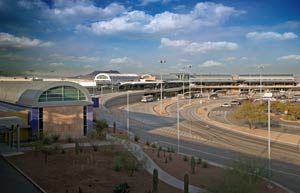
Tucson International Airport
Tucson International Airport (IATA: TUS, ICAO: KTUS, FAA LID: TUS) is a civil-military airport owned by the city of Tucson 8 miles (7.0 nmi; 13 km) south of downtown Tucson, in Pima County, Arizona, United States. It is the second busiest airport in Arizona, after Phoenix Sky Harbor International Airport. The National Plan of Integrated Airport Systems for 2025–2029 categorized it as a primary commercial service airport since it has over 10,000 passenger boardings per year and as a small hub since it receives between 0.05% and 0.25% of annual U.S. commercial enplanements (0.2% of 2023 U.S. commercial enplanements to be more precise). Federal Aviation Administration records say the airport had 1,959,789 enplanements in 2024, an increase from 1,925,546 in 2023. Tucson International is operated on a long-term lease by the Tucson Airport Authority, which also operates Ryan Airfield, a general aviation airport. Public transportation to the airport is Sun Tran bus routes No. 11 and No. 25.
Location

32.115°N, 110.938°O · 806 m s. n. m. (2.643 ft)
General data
Runways · 2
Lengths and surfaces from the public OurAirports register; open runways only.
Radio frequencies · 6
Tower
Ground
Clearance delivery
ATIS (automatic information)
Approach
UNICOM
Reference frequencies for enthusiasts, from OurAirports (community database, public domain), checked on Oct 16, 2026. They may be outdated or incomplete and do not replace the AIP or current charts: not for navigation. In Europe the published frequency may be an 8.33 kHz channel (e.g., 118.505 for 118.500). In MHz.
History
In 1919, Tucson opened the first municipally owned airport in the United States. In 1928 commercial flights began with Standard Airlines (later American Airlines); regular airmail service began in 1930. The 1936 airport directory shows Tucson Municipal at 32°11′N 110°55′W "just north of the railroad" (since removed) referring to the site that was then being used as the city's airport southeast of the intersection of S. Park Avenue and E. 36th Street.
During World War II the airfield was used by the United States Army Air Forces Air Technical Service Command. A contract flying school was operated by the USAAF West Coast Training Center from July 25, 1942, until September 1944.
In 1948, the Tucson Airport Authority was created as a non-profit corporation to operate the airport and oversee policy decisions. The nine member board is elected by a group of up to 115 volunteer residents from Pima County, Arizona. The airport was moved to its current location south of Valencia Road and operated on the west ramp out of three hangars vacated by World War II military manufacturing companies. A new control tower was constructed in 1958 to replace the original WWII wooden framed version.
The Tucson Airport Authority was also involved in bringing the Hughes Missile Plant, now known as Air Force Plant 44 and operated by Raytheon, to Tucson. TAA sold the land to the Hughes Aircraft Co., for the construction of the plant.
In March 1956, the Civil Aeronautics Board approved routes out of Tucson for Trans World Airlines (TWA), over opposition from American Airlines, but flights did not begin until December of that year.
In April 1957, airlines scheduled 21 departures a day: 15 American, 4 TWA, and 2 Frontier. The first jet flights were American Airlines Boeing 707s and Boeing 720s around September 1960. American began flying wide-body McDonnell Douglas DC-10s from Tucson nonstop to Dallas/Ft. Worth and to Chicago via Phoenix beginning in fall 1971 and continuing through the 1970s. In 1981, Eastern Airlines was operating direct Airbus A300 wide-body service to Atlanta via an en-route stop in Phoenix. In the late 1980s American was flying Boeing 767-200s nonstop to Dallas/Ft. Worth. The DC-10, A300, and 767 were the largest airliners ever to serve Tucson on scheduled passenger flights.
On November 15, 1963, a new terminal designed by Terry Atkinson opened with an international inspection station. The Tucson International Airport name was legitimate: Aeronaves de Mexico had begun Douglas DC-6 service to Hermosillo and beyond in 1961. In the mid-1970s successor airline Aeromexico flew McDonnell Douglas DC-9-30s nonstop to Hermosillo and on to Ciudad Obregon, Culiacan, Guadalajara and Mexico City. Bonanza Air Lines began DC-9 jet service to Mexico in the late 1960s with flights to Mazatlan, La Paz and Puerto Vallarta, and successor airlines Air West and Hughes Airwest flew DC-9s from Tucson to Mexico with their service being extended to Guadalajara, Mazatlan, La Paz and Puerto Vallarta. By late 1989, three Mexican air carriers were serving the airport: Aero California with nonstop Douglas DC-9-10 jet service from Los Cabos, Aeromexico with nonstop McDonnell Douglas DC-9-30 jet service from both Guaymas and Hermosillo, and Aviacion del Noroeste with nonstop Fokker F27 turboprop service from Hermosillo.
The terminal underwent minor remodeling during the 1960s and 1970s, and its interior was featured in the 1974 film Death Wish starring Charles Bronson.
From the early 1970s to the early 1980s Cochise Airlines was based in Tucson. This commuter airline operated Cessna 402s, Convair 440s, de Havilland Canada DHC-6 Twin Otters and Swearingen Metroliners. Cochise scheduled passenger flights to cities in Arizona and southern California.
A remodeling in 1985 doubled the size of the terminal from 150,000 to 300,000 sq ft and rebuilt the concourse into separate, two-level structures with jet bridges.
In 1987 the airport lengthened the primary runway a half-mile to the southeast for noise abatement reasons and installed arresting barriers for military planes.
A Concourse Renovation Project was finished in 2005—the last phase of a remodeling begun in 2000 that added 82,000 sq ft (7,600 m2) to ticketing and baggage claim designed by HNTB. On March 19, 2008, the previous East and West concourses and gates were renumbered with the East Concourse becoming Concourse A: Gates A1–A9, and the West Concourse becoming Concourse B: Gates B1–B11.
In 2019, the Tucson Airport became the third facility in Arizona with an ATP Flight School training center.
In January 2014, the Tucson Airport Authority board approved a no-cost, 20-year property lease with the Federal Aviation Administration for a property on which to build a new federally-funded control tower to replace the 1950s vintage tower currently in use. The new tower is located on the south side of the airport, near Aero Park Blvd.
On April 6, 2016, the Tucson Airport Authority announced the Terminal Optimization Program (TOP).
What flies here
From our own logbook: 1,070 aircraft documented between 2006 and 2025.
Types seen here
 Bombardier CRJ258
 Embraer E170 / E175186
 McDonnell Douglas MD-80131
 Embraer ERJ 135 / 145116
 Boeing 737112
 Airbus A32165
 Airbus A32033
 Airbus A31913
 Boeing 737 MAX4
 Boeing 7574
Airlines with documented aircraft
Busiest routes from here
A count of our own aircraft profiles, year by year, from the public United States flight records: it reflects what we have documented, not the airport’s total traffic.
Airlines operating here · 10
Other airlines with direct routes
Airlines with current passenger routes from here, according to Wikipedia route tables cross-checked from both ends (October 2026).
Photo: The original uploader was Sox23 at English Wikipedia. · CC BY-SA 3.0 · view original
Data from OurAirports (public domain) · destinations and airlines from Wikipedia route tables (CC BY-SA, 2026), unless another source is given · profile and photo from Wikidata/Wikimedia Commons (CC0 / CC) · summary and history from Wikipedia (CC BY-SA).
Cite
To cite this page in academic work, an article or Wikipedia, choose the style and copy the reference. The access date is today.
This page was last updated on October 15, 2026
APA
Vuelopedia. (2026, October 15). Tucson International Airport (TUS). Retrieved October 16, 2026, from https://vuelopedia.org/en/airport/TUS
MLA
“Tucson International Airport (TUS).” Vuelopedia, Fundación Poderia, 15 Oct. 2026, vuelopedia.org/en/airport/TUS. Accessed 16 Oct. 2026.
Chicago
Vuelopedia. “Tucson International Airport (TUS).” Fundación Poderia. Last modified October 15, 2026. https://vuelopedia.org/en/airport/TUS.
Harvard
Vuelopedia (2026) Tucson International Airport (TUS). Available at: https://vuelopedia.org/en/airport/TUS (Accessed: 16 October 2026).
BibTeX
@misc{vuelopedia_en_airport_tus,
  author       = {{Vuelopedia}},
  title        = {{Tucson International Airport (TUS)}},
  publisher    = {Fundación Poderia},
  year         = {2026},
  date         = {2026-10-15},
  url          = {https://vuelopedia.org/en/airport/TUS},
  howpublished = {\url{https://vuelopedia.org/en/airport/TUS}},
  urldate      = {2026-10-16},
  note         = {Accessed 2026-10-16}
}Wikipedia
{{cite web |url=https://vuelopedia.org/en/airport/TUS |title=Tucson International Airport (TUS) |website=Vuelopedia |publisher=Fundación Poderia |date=2026-10-15 |access-date=2026-10-16 |language=en}}