

Lubbock Preston Smith International Airport
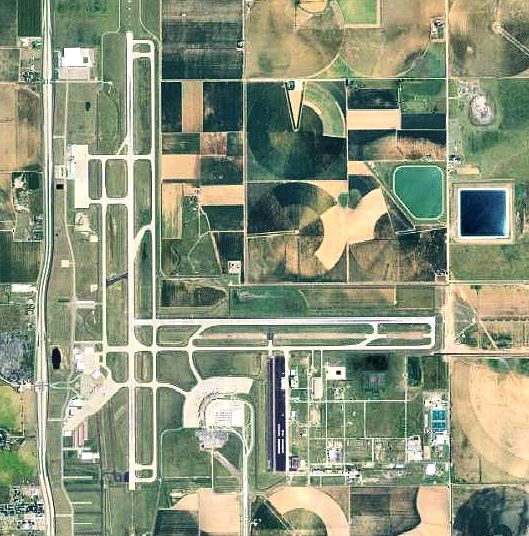
Lubbock Preston Smith International Airport
Lubbock Preston Smith International Airport (IATA: LBB, ICAO: KLBB, FAA LID: LBB) is five miles north of Lubbock, in Lubbock County, Texas, United States. Originally Lubbock International Airport, it was renamed in 2004 for former Texas governor Preston E. Smith, an alumnus of Texas Tech University. The National Plan of Integrated Airport Systems for 2011–2015 classifies it as a primary commercial service airport. Federal Aviation Administration records say the airport had 520,181 passenger boardings (enplanements) in calendar year 2019, and 487,000 in 2018. The airport is the eighth-busiest airport in Texas. Lubbock International is first among the smaller Texas cities (behind both Dallas airports, both Houston airports, San Antonio, Austin, and El Paso). Lubbock Preston Smith International Airport is a hub for FedEx and UPS feeder planes to cities around the South Plains.
Location

33.664°N, 101.823°O · 1.000 m s. n. m. (3.282 ft)
General data
Runways · 3
Lengths and surfaces from the public OurAirports register; open runways only.
Radio frequencies · 8 Official publication
Tower
Ground
Clearance delivery
ATIS (automatic information)
Approach
Departure
UNICOM
Frequencies from the official publication: FAA NASR, AIRAC 01 OCT 2026, checked on Oct 16, 2026. They change with each amendment: not for navigation without checking the current AIP. See the official publication In MHz.
History
The airport opened in November 1937 as South Plains Airport. In 1942 the United States Army Air Forces indicated a need for the airport as a training airfield. After its requisition by the Air Force, it was assigned to the World War II Army Air Forces Flying Training Command, Gulf Coast Training Center (later Central Flying Training Command). The airport was renamed South Plains Army Airfield and a rapid period of construction was begun to convert the civil airport into a military training airfield.
Construction involved runways and airplane hangars, with three concrete runways, several taxiways and a large apron and a control tower. Several large hangars were also built. Buildings were utilitarian and quickly assembled. Most base buildings, not meant for long-term use, were of temporary or semi-permanent materials. Some hangars had steel frames and the occasional brick or tile brick building could be seen, but most support buildings had concrete foundations and frame construction clad in little more than plywood and tarpaper.
The base was activated on September 11, 1942, as the South Plains Flying School. The mission was ground and flying training of glider pilots. Glider training was performed by the 848th School Squadron (Special), with overall training being under the 64th Two-Engine Flying Training Group of the 80th Flying Training Wing. Aircraft assigned were Douglas C-47 Skytrains and Waco CG-4A gliders. The CG-4A was the USAAF's primary glider, consisting of little more than a wooden and fabric shell, equipped with radio, wheels, and brakes. Glider pilots trained at South Plains flew these craft in combat during the Normandy Invasion, Operation Market-Garden, and also Operation Varsity, the airborne invasion of Germany.
By late 1944 Flying Training Command ended all glider instruction, and control of South Plains AAF was transferred to the Air Service Command at Tinker Field, Oklahoma. Under Air Service Command, South Plains became a maintenance and supply depot for excess aircraft that could not be accommodated at Tinker. After the war ended, in 1946 and 1947, South Plains was used as a storage facility for excess aircraft prior to their reclamation.
Military use of South Plains ended on December 1, 1947, and it was returned to the local government for civil use. A civilian terminal was constructed on the southwest corner of the airfield for commercial airline activity and used through the 1950s and 1960s. The current airline terminal was opened about 1976. The original terminal now houses the Silent Wings Museum dedicated to World War II glider pilots.
Major renovations to the terminal building began in 2019, featuring an expanded TSA screening area, refreshed check-in counters, gates, waiting areas, restrooms, concessions, rental-car desks and more. Many of these improvements began to open to the public in late 2021.
Historical airline service
Braniff Airways, later to be Braniff International Airways, Continental Airlines, and Pioneer Air Lines all began scheduled passenger flights to Lubbock by 1945. Braniff began with an Amarillo-Lubbock-Dallas route, Continental with a multi-stop route between El Paso and Tulsa, and Pioneer with a multi-stop route between Amarillo and Houston. Pioneer later added flights on a multi-stop route between Albuquerque and Dallas. Pioneer merged into Continental Airlines in 1955 and then Trans-Texas Airways took over the Albuquerque to Dallas route in 1963. By then Continental was flying nonstop to Dallas, Albuquerque, and El Paso however the flight to Tulsa still made stops at Wichita Falls, Lawton, and Oklahoma City. Flights to Houston stopped at Midland/Odessa and San Antonio.
Airline jets arrived in 1965 on Braniff International Airways and 1966 on Continental Airlines. In spring 1966 Braniff BAC One-Elevens flew nonstop to Dallas Love Field and Amarillo, in addition to Lockheed L-188 Electra and Convair 340 flights, while Continental Douglas DC-9-10s flew nonstop to Dallas Love Field and El Paso in addition to Vickers Viscount flights. Trans-Texas Airways became Texas International in 1969 and began jet service with DC-9's on a Denver-Amarillo-Lubbock-Austin-Houston route.
By 1976 all scheduled passenger airline flights at Lubbock were jets: Braniff Boeing 727-100s and Boeing 727-200s, Continental 727-200s and Texas International Airlines Douglas DC-9-10s. A 1976 OAG lists nonstop jets to Lubbock from Albuquerque, Amarillo, Austin, Dallas/Fort Worth (DFW), El Paso, Midland/Odessa and Wichita Falls and direct jets from Colorado Springs, Corpus Christi, Denver, Houston (IAH), Lawton, Los Angeles (LAX), Oklahoma City, San Antonio and Tulsa. Braniff Boeing 727s flew direct from Lubbock to New York Newark Airport, Washington D.C. National Airport and Nashville.
Southwest Airlines began serving Lubbock on May 20, 1977, as an intrastate airline with Boeing 737-200s to Dallas Love Field, Houston Hobby Airport, San Antonio, Corpus Christi and Harlingen. By 1978 Southwest had added nonstop 737 jet flights to El Paso in addition to nonstop jets to Dallas Love Field and Houston Hobby Airport and direct jets to other Texas cities.
What flies here
From our own logbook: 344 aircraft documented between 2006 and 2025.
Types seen here
 Embraer ERJ 135 / 145116
 Bombardier CRJ109
 Embraer E170 / E17554
 Boeing 73725
 Airbus A3193
 Boeing 737 MAX1
Airlines with documented aircraft
Busiest routes from here
A count of our own aircraft profiles, year by year, from the public United States flight records: it reflects what we have documented, not the airport’s total traffic.
Airlines operating here · 5
Other airlines with direct routes
Airlines with current passenger routes from here, according to Wikipedia route tables cross-checked from both ends (October 2026).
Photo: United States Geological Survey (USGS) · Public domain · view original
Data from OurAirports (public domain) · destinations and airlines from Wikipedia route tables (CC BY-SA, 2026), unless another source is given · profile and photo from Wikidata/Wikimedia Commons (CC0 / CC) · summary and history from Wikipedia (CC BY-SA).
Cite
To cite this page in academic work, an article or Wikipedia, choose the style and copy the reference. The access date is today.
This page was last updated on October 16, 2026
APA
Vuelopedia. (2026, October 16). Lubbock Preston Smith International Airport (LBB). Retrieved October 16, 2026, from https://vuelopedia.org/en/airport/LBB
MLA
“Lubbock Preston Smith International Airport (LBB).” Vuelopedia, Fundación Poderia, 16 Oct. 2026, vuelopedia.org/en/airport/LBB. Accessed 16 Oct. 2026.
Chicago
Vuelopedia. “Lubbock Preston Smith International Airport (LBB).” Fundación Poderia. Last modified October 16, 2026. https://vuelopedia.org/en/airport/LBB.
Harvard
Vuelopedia (2026) Lubbock Preston Smith International Airport (LBB). Available at: https://vuelopedia.org/en/airport/LBB (Accessed: 16 October 2026).
BibTeX
@misc{vuelopedia_en_airport_lbb,
  author       = {{Vuelopedia}},
  title        = {{Lubbock Preston Smith International Airport (LBB)}},
  publisher    = {Fundación Poderia},
  year         = {2026},
  date         = {2026-10-16},
  url          = {https://vuelopedia.org/en/airport/LBB},
  howpublished = {\url{https://vuelopedia.org/en/airport/LBB}},
  urldate      = {2026-10-16},
  note         = {Accessed 2026-10-16}
}Wikipedia
{{cite web |url=https://vuelopedia.org/en/airport/LBB |title=Lubbock Preston Smith International Airport (LBB) |website=Vuelopedia |publisher=Fundación Poderia |date=2026-10-16 |access-date=2026-10-16 |language=en}}