

Nashville International Airport
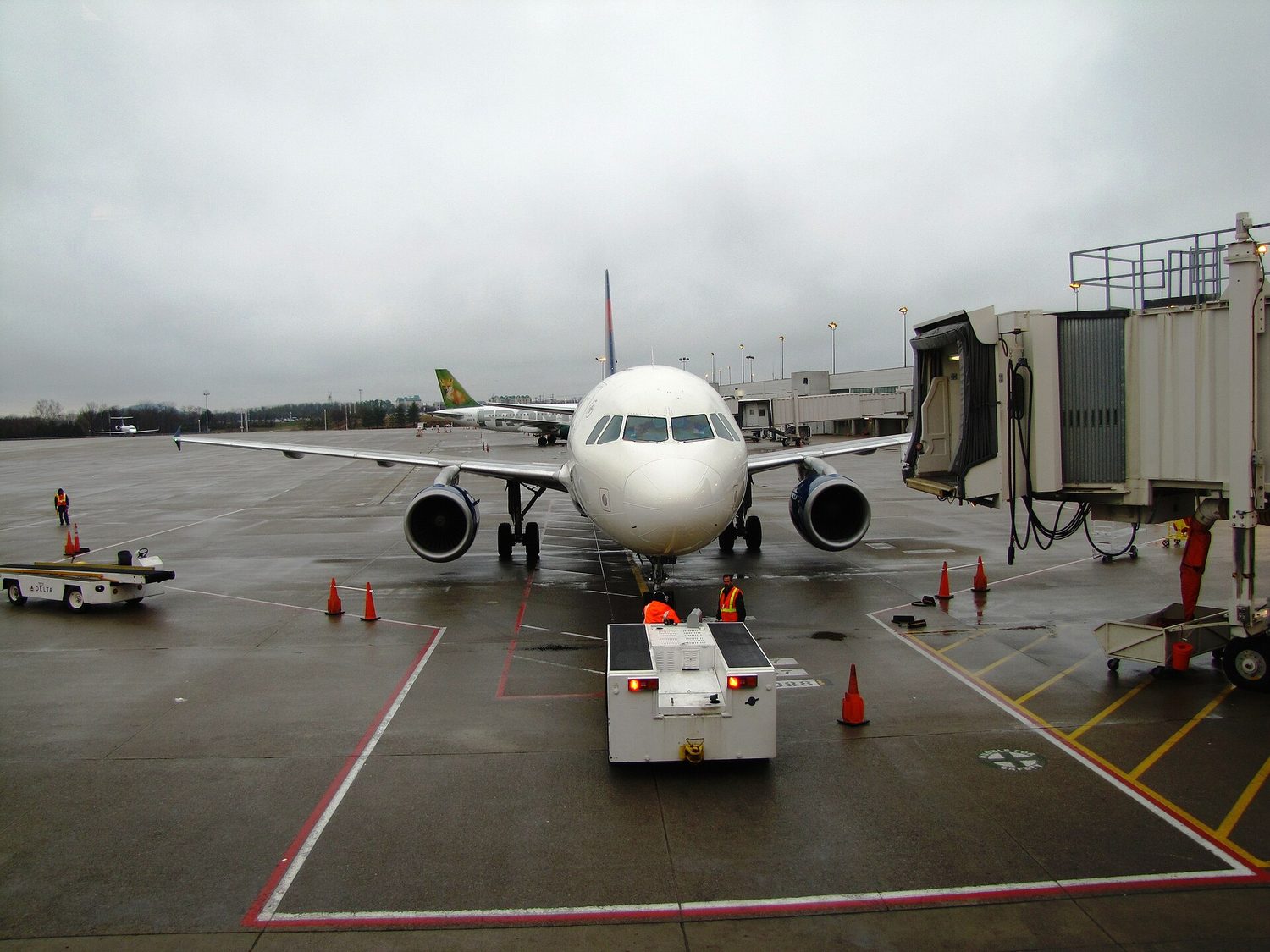
Nashville International Airport
Nashville International Airport (IATA: BNA, ICAO: KBNA, FAA LID: BNA) is a public/military airport in the southeastern section of Nashville, Tennessee, United States. Established in 1937, its original name was Berry Field, from which its ICAO and IATA identifiers are derived. The current terminal was built in 1987, and the airport took its current name in 1988. Nashville International Airport has four runways and covers 4,555 acres (1,843 ha) of land. It is the busiest airport in Tennessee, with more boardings and arrivals than all other airports in the state combined. The airport was first served by American Airlines and Eastern Air Lines and was a hub for American in the late 20th century. The airport now offers service to 99 destinations across the United States as well as a number of international destinations. In 2022, it averaged 600 daily aircraft movements. Joint Base Berry Field, formerly Berry Field Air National Guard Base, is located at Nashville International Airport. The base is home to the 118th Wing and the 1/230th Air Cavalry Squadron Tennessee Army National Guard.
Location

36.124°N, 86.678°O · 183 m s. n. m. (599 ft)
General data
Runways · 4
Lengths and surfaces from the public OurAirports register; open runways only.
Radio frequencies · 7
Tower
Ground
Clearance delivery
ATIS (automatic information)
Approach
Departure
UNICOM
Reference frequencies for enthusiasts, from OurAirports (community database, public domain), checked on Oct 16, 2026. They may be outdated or incomplete and do not replace the AIP or current charts: not for navigation. In Europe the published frequency may be an 8.33 kHz channel (e.g., 118.505 for 118.500). In MHz.
History
Nashville's first airport was Hampton Field, which operated until 1921. It was replaced by Blackwood Field in the Hermitage community, which operated between 1921 and 1928. The first airlines to serve Nashville, American Airlines and Eastern Air Lines, flew out of Sky Harbor Airport in nearby Rutherford County. By 1935, the need for an airport larger and closer to the city than Sky Harbor Airport was realized and a citizens' committee was organized by mayor Hilary Ewing Howse to choose a location. A 340-acre (1.4 km2) plot along Dixie Parkway (now Murfreesboro Pike) composed of four farms was selected, and construction began in 1936 as one of the first major Works Progress Administration projects in the area. The airport was dedicated on November 1, 1936 as Berry Field, named after Col. Harry S. Berry, the Tennessee administrator for the Works Progress Administration. It opened in June 1937 with much fanfare, including parades, an air show and an aerial bombardment display by the 105th Aero Squadron, which was based at the field. Passenger service began in mid-July through American Airlines and Eastern Airlines, both of which operated Douglas DC-3s. The new airport had three asphalt runways, a three-story passenger terminal, a control tower, two hangars and a beacon, and was built at a cost of $1.2 million. In its first year, Berry Field served 189,000 passengers. During World War II, the airfield was requisitioned by the United States Army Air Forces Air Transport Command as the headquarters for the 4th Ferrying Command for movement of new aircraft overseas. During this time, the federal government expanded the airport to 1,500 acres (6.1 km2). At the end of the war, the airport was returned to the control of the city, with a number of facilities remaining for support of the tenant unit of the Tennessee National Guard. The airport had been enlarged by the military during World War II, but in 1958 the city aviation department started planning to expand and modernize the airport. In 1961, a new 145,000 square feet (13,500 m2) terminal opened by Briley Parkway, west of Runway 2L. In that year, the first jets at Berry Field, American Airlines 720/720Bs, began scheduled service, and the six airlines that served Nashville carried 532,790 passengers. These renovations also included expansion of an existing runway, with 2L/20R extended by 600 feet (180 m), and the construction of a new crosswind runway, 13/31. In 1962, Nashville became the first municipal airport in the United States with a public reading room when the Nashville Public Library opened a branch inside the terminal. By the 1970s, the airport was again in need of expansion and modernization. In 1973, the newly created Metropolitan Nashville Airport Authority (MNAA) finalized a plan for the long-term growth of the airport; the plan included a new terminal and a new parallel runway across Donelson Pike to increase capacity by reducing time between takeoffs and landings. In the early 1980s, the MNAA commissioned Robert Lamb Hart, in association with the firm of Gresham, Smith and Partners, to design a modern terminal; construction began on the opposite side of the existing two crossing runways in 1984 and was completed in 1987. The new terminal had three main concourses and a smaller commuter concourse radiating from a distinctive three-story atrium. An international wing was built in Concourse A, and the airport was renamed Nashville International Airport/Berry Field. Although the Berry Field name is rarely used, the airport's IATA code of BNA is short for Berry Field Nashville, and the military facilities at the airport are still commonly known by this name. In 1989, a new parallel runway (2R/20L) was opened for use. American Airlines announced in 1985 that it would establish a hub at Nashville, and it officially opened in 1986.
What flies here
From our own logbook: 4,133 aircraft documented between 2006 and 2025.
Types seen here
 Boeing 7371,467
 Embraer E170 / E175510
 Boeing 737 MAX337
 Bombardier CRJ329
 Airbus A319278
 McDonnell Douglas MD-80272
 Embraer ERJ 135 / 145209
 Airbus A320175
 Boeing 71783
 Airbus A32182
Airlines with documented aircraft
Busiest routes from here
A count of our own aircraft profiles, year by year, from the public United States flight records: it reflects what we have documented, not the airport’s total traffic.
Airlines operating here · 22
Airlines using it as a main base (hub)
Other airlines with direct routes
Airlines with current passenger routes from here, according to Wikipedia route tables cross-checked from both ends (October 2026).
Photo: redlegsfan21 from Vandalia, OH, United States · CC BY-SA 2.0 · view original
Data from OurAirports (public domain) · destinations and airlines from Wikipedia route tables (CC BY-SA, 2026), unless another source is given · profile and photo from Wikidata/Wikimedia Commons (CC0 / CC) · summary and history from Wikipedia (CC BY-SA).
Cite
To cite this page in academic work, an article or Wikipedia, choose the style and copy the reference. The access date is today.
This page was last updated on October 15, 2026
APA
Vuelopedia. (2026, October 15). Nashville International Airport (BNA). Retrieved October 16, 2026, from https://vuelopedia.org/en/airport/BNA
MLA
“Nashville International Airport (BNA).” Vuelopedia, Fundación Poderia, 15 Oct. 2026, vuelopedia.org/en/airport/BNA. Accessed 16 Oct. 2026.
Chicago
Vuelopedia. “Nashville International Airport (BNA).” Fundación Poderia. Last modified October 15, 2026. https://vuelopedia.org/en/airport/BNA.
Harvard
Vuelopedia (2026) Nashville International Airport (BNA). Available at: https://vuelopedia.org/en/airport/BNA (Accessed: 16 October 2026).
BibTeX
@misc{vuelopedia_en_airport_bna,
  author       = {{Vuelopedia}},
  title        = {{Nashville International Airport (BNA)}},
  publisher    = {Fundación Poderia},
  year         = {2026},
  date         = {2026-10-15},
  url          = {https://vuelopedia.org/en/airport/BNA},
  howpublished = {\url{https://vuelopedia.org/en/airport/BNA}},
  urldate      = {2026-10-16},
  note         = {Accessed 2026-10-16}
}Wikipedia
{{cite web |url=https://vuelopedia.org/en/airport/BNA |title=Nashville International Airport (BNA) |website=Vuelopedia |publisher=Fundación Poderia |date=2026-10-15 |access-date=2026-10-16 |language=en}}