

Denpasar I Gusti Ngurah Rai International Airport
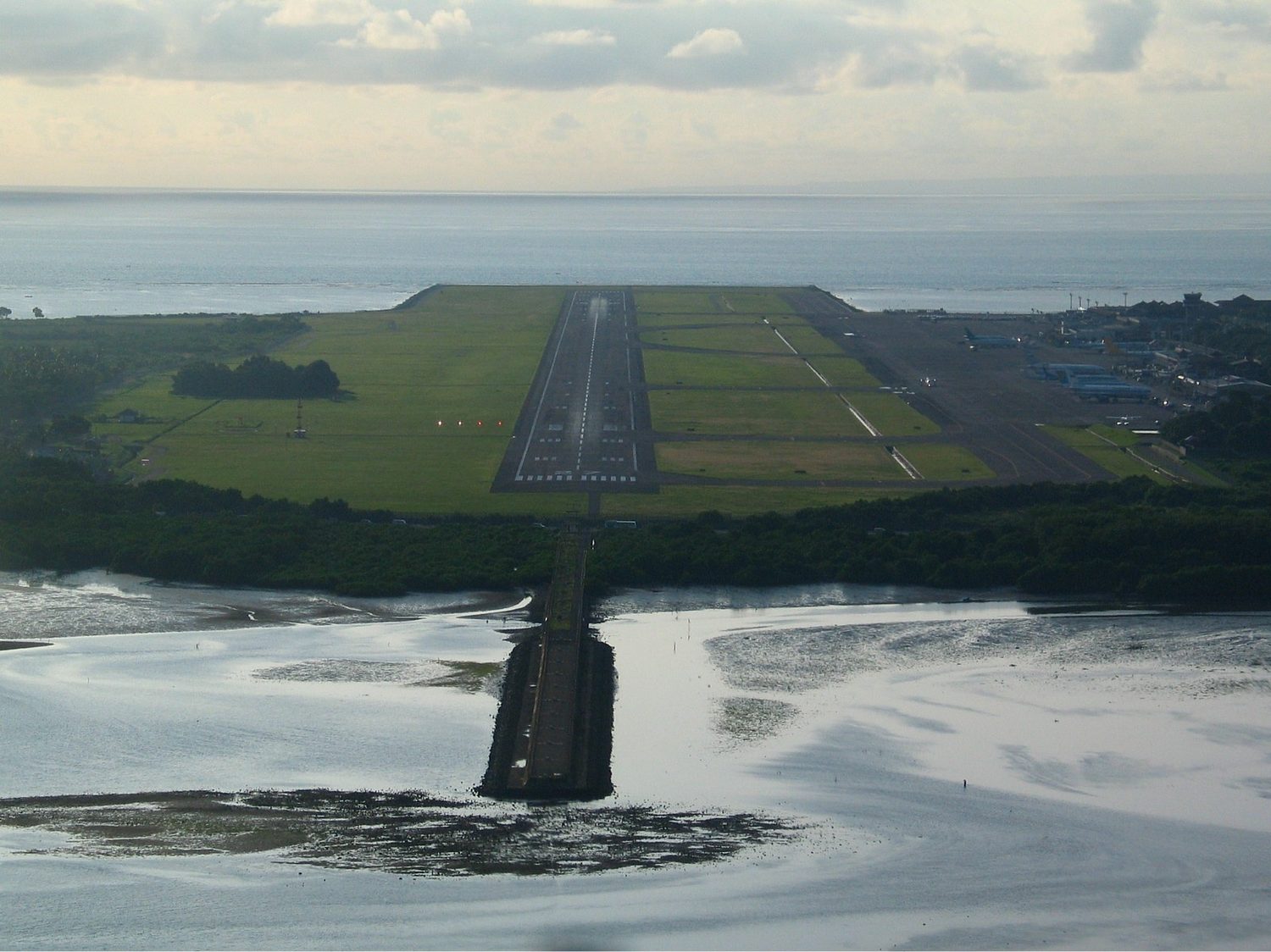
Denpasar I Gusti Ngurah Rai International Airport
I Gusti Ngurah Rai International Airport (IATA: DPS, ICAO: WADD), commonly known simply as Ngurah Rai International Airport, and also known as Denpasar International Airport or Bali Airport, is the main international airport serving the island of Bali, Indonesia. It is the island's only airport handling scheduled commercial flights. The airport is named after I Gusti Ngurah Rai, a Balinese national hero who was killed on 20 November 1946 during the Battle of Margarana (Puputan Margarana) in Tabanan. He and his troops were defeated by Dutch forces with air support during the Indonesian National Revolution, resulting in his death along with 95 of his men. Located in Tuban, Badung Regency, approximately 13 kilometres (8.1 mi) south of Denpasar, the airport serves the Denpasar metropolitan area as well as the entire island of Bali. It offers domestic connections to major Indonesian cities and international routes to destinations across Australia, New Zealand, Southeast Asia, East Asia, Europe, and the Middle East. I Gusti Ngurah Rai International Airport is the second-busiest airport in Indonesia after Soekarno–Hatta International Airport in Jakarta and serves as a hub for airlines such as Garuda Indonesia and Batik Air. The airport is classified as Category IX, enabling it to accommodate wide-body aircraft, including the Boeing 747-8 and Airbus A380.
Location

8.748°S, 115.167°E · 4 m s. n. m. (14 ft)
General data
Runways · 1
Lengths and surfaces from the public OurAirports register; open runways only.
Radio frequencies · 5
Tower
Ground
ATIS (automatic information)
Approach
Reference frequencies for enthusiasts, from OurAirports (community database, public domain), checked on Oct 16, 2026. They may be outdated or incomplete and do not replace the AIP or current charts: not for navigation. In Europe the published frequency may be an 8.33 kHz channel (e.g., 118.505 for 118.500). In MHz.
History
Colonial era
In the early 1930s, the Dutch colonial government constructed an airfield at Tuban, situated at the narrowest point along Bali's southern coast. Initially known as Tuban Airfield, it consisted of a simple 700-metre grass strip built by the Dutch East Indies' Voor Verkeer en Waterstaat (Department of Transport, Public Works and Water Management). At the time, the facility was rudimentary, with only a few huts and a short runway. Alongside the 700-metre grass runway, the airstrip was situated near a cemetery in the village of Tuban. Due to its location within the village, the surrounding community commonly referred to it as Tuban Airfield. In early 1935, an Imperial Airways de Havilland Express attempted to land at Tuban Airfield on the 700-meter runway, in which at that time 250 meters had been paved. The airline intended to use this airstrip as an overnight stop before continuing to Makassar. At the time, its aircraft routinely landed and stayed overnight at Rambang in Lombok before proceeding to Makassar the following day. Imperial Airways requested that the airstrip be repaired, reinforced, and, if possible, equipped with communication facilities linked to Surabaya. When no immediate response was received, the airline followed up by asking whether the Dutch East Indies authorities, including the Dutch East Indies’ national carrier, Koninklijke Nederlandsch-Indische Luchtvaart Maatschappij (KNILM), expected Imperial Airways to finance the necessary improvements. At the time, the Dutch colonial administration and KNILM had initially opposed the development of the airfield, likely due to the considerable costs involved. By that time, the airfield was already serving commercial operations, including regular flights operated by KNILM, which connected Bali with Surabaya. In January 1938, the airfield was finally rebuilt and upgraded to accommodate larger American aircraft such as the Douglas DC-3; previously, it had been limited to handling aircraft no larger than the Fokker F.VII.
In 1942, following the outbreak of the Pacific War during World War II, the airfield was used to stage fighter and bomber operations. The Japanese sought to capture the airfield as a support base for their planned assault on Java. At the time, the facility had been abandoned, with no aircraft of the Royal Netherlands East Indies Army Air Force (ML-KNIL) present. On 16 February 1942, Japanese forces launched an air raid on the airfield, rendering it inoperable. In its aftermath, the poorly motivated garrison of around 600 Dutch-led Balinese militia quickly deserted as Japanese troops advanced on the island, while their Dutch officers fled to Java. The Dutch attempted to destroy the airfield to prevent it from falling into Japanese hands. However, the commander later discovered that, due to a misunderstanding of orders, the demolition had not been carried out as intended. His instruction not to delay the destruction was misinterpreted by the engineers, who instead believed the operation should be postponed. As a result, Japanese forces were able to capture the airfield intact on 19 February. By the following day, Mitsubishi A6M Zero fighters of the Imperial Japanese Naval Air Service had landed at the captured airfield, preparing for air raids against Allied positions on Java. The capture of the airfield effectively cut off reinforcement routes from Australia, as Japanese forces gained air superiority and were able to intercept incoming aircraft over the sea before they could land, further sealing the fate of the Dutch East Indies.
During the Japanese occupation from 1942 to 1945, the airport's runway was improved and repaired, including the use of pierced steel plates to restore damaged sections. Between 1942 and 1947, the runway was extended from 700 to 1,200 meters, and the Japanese constructed extensive additional facilities at the airfield to support their military operations. The airfield was used by the Imperial Japanese Naval Air Service throughout the war and served as a base for the Tainan Air Group during the campaign in Java; however, no significant Japanese fighter squadron was stationed in Denpasar thereafter. Nevertheless, the capture of Tuban Airfield and the island of Bali deprived the Allied forces of a key fighter staging point along the route from Australia to Java. Throughout the war, Allied forces repeatedly targeted the airfield with air raids in an effort to render it inoperable.
After the Japanese surrender in 1945, the airfield briefly came under the control of local Indonesian militias before being handed over to the Netherlands Indies Civil Administration (NICA) in 1946. In 1949, a terminal building and other basic aviation facilities were constructed, along with a simple wooden air traffic control tower. Air-to-ground communications at the time were conducted using Morse code transceivers.
Post-independence era
Following the Dutch recognition of Indonesian sovereignty, control of the airfield was transferred to Indonesian authorities in 1950. President Soekarno was recorded landing at Tuban Airfield in 1955 aboard a Douglas DC-3.
Airlines operating here · 55
Airlines using it as a main base (hub)
Other airlines with direct routes
Airlines with current passenger routes from here, according to Wikipedia route tables cross-checked from both ends (October 2026).
Photo: M Radzi Desa · GFDL 1.2 · view original
Data from OurAirports (public domain) · destinations and airlines from Wikipedia route tables (CC BY-SA, 2026), unless another source is given · profile and photo from Wikidata/Wikimedia Commons (CC0 / CC) · summary and history from Wikipedia (CC BY-SA).
Cite
To cite this page in academic work, an article or Wikipedia, choose the style and copy the reference. The access date is today.
This page was last updated on October 15, 2026
APA
Vuelopedia. (2026, October 15). Denpasar I Gusti Ngurah Rai International Airport (DPS). Retrieved October 16, 2026, from https://vuelopedia.org/en/airport/DPS
MLA
“Denpasar I Gusti Ngurah Rai International Airport (DPS).” Vuelopedia, Fundación Poderia, 15 Oct. 2026, vuelopedia.org/en/airport/DPS. Accessed 16 Oct. 2026.
Chicago
Vuelopedia. “Denpasar I Gusti Ngurah Rai International Airport (DPS).” Fundación Poderia. Last modified October 15, 2026. https://vuelopedia.org/en/airport/DPS.
Harvard
Vuelopedia (2026) Denpasar I Gusti Ngurah Rai International Airport (DPS). Available at: https://vuelopedia.org/en/airport/DPS (Accessed: 16 October 2026).
BibTeX
@misc{vuelopedia_en_airport_dps,
  author       = {{Vuelopedia}},
  title        = {{Denpasar I Gusti Ngurah Rai International Airport (DPS)}},
  publisher    = {Fundación Poderia},
  year         = {2026},
  date         = {2026-10-15},
  url          = {https://vuelopedia.org/en/airport/DPS},
  howpublished = {\url{https://vuelopedia.org/en/airport/DPS}},
  urldate      = {2026-10-16},
  note         = {Accessed 2026-10-16}
}Wikipedia
{{cite web |url=https://vuelopedia.org/en/airport/DPS |title=Denpasar I Gusti Ngurah Rai International Airport (DPS) |website=Vuelopedia |publisher=Fundación Poderia |date=2026-10-15 |access-date=2026-10-16 |language=en}}