

Toronto Pearson International Airport
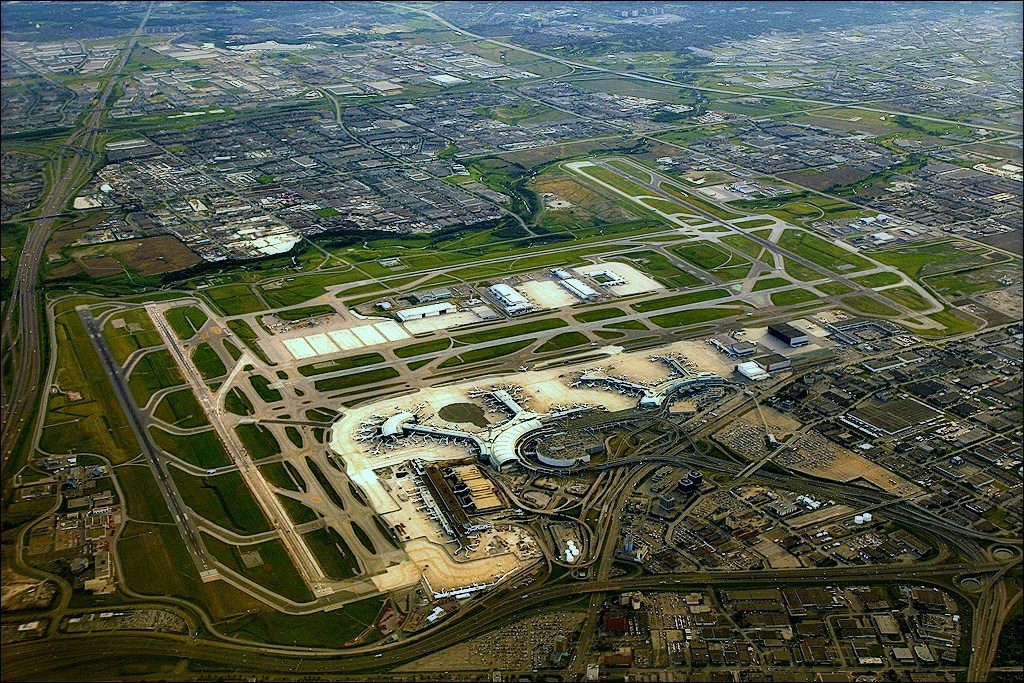
Toronto Pearson International Airport
Toronto Pearson International Airport (IATA: YYZ, ICAO: CYYZ) is an international airport primarily located in Mississauga, Ontario, Canada. It is the main airport serving Toronto, its metropolitan area, and the surrounding region known as the Golden Horseshoe. Pearson is the largest and busiest airport in Canada, and the 49th-busiest airport in the world, handling 47.3 million passengers in 2025. It is named in honour of Lester B. Pearson (1897–1972), the 14th Prime Minister of Canada and 1957 Nobel Peace Prize laureate. Pearson International Airport is situated 20 kilometres (12 mi) northwest of downtown Toronto in the adjacent city of Mississauga, with a small portion of the airfield extending into Toronto's western district of Etobicoke. It has five runways and two passenger terminals along with numerous cargo, maintenance, and aerospace production facilities on a site that covers 1,867 hectares (4,613 acres). Toronto Pearson is the primary global hub for Air Canada. It also serves as a hub for Porter Airlines and WestJet, as a focus city for Air Transat, and a base of operations for Flair Airlines. Pearson is operated by the Greater Toronto Airports Authority (GTAA) as part of Transport Canada's National Airports System and is supported by around 50,000 workers. The airport maintains facilities for United States border preclearance.
Location

43.676°N, 79.629°O · 173 m s. n. m. (569 ft)
General data
Runways · 5
Lengths and surfaces from the public OurAirports register; open runways only.
Radio frequencies · 11
Tower
Ground
Clearance delivery
Approach
Departure
Flight information
Apron
Reference frequencies for enthusiasts, from OurAirports (community database, public domain), checked on Oct 16, 2026. They may be outdated or incomplete and do not replace the AIP or current charts: not for navigation. In Europe the published frequency may be an 8.33 kHz channel (e.g., 118.505 for 118.500). In MHz.
History
In 1937, the Government of Canada agreed to support the building of two airports in the Toronto area. One site selected was on the Toronto Islands, which is the present-day Billy Bishop Toronto City Airport. The other site selected was at Elmbank, northwest of Toronto near the town of Malton in what was then Toronto Township (which would later become Mississauga to avoid confusion with the nearby city of Toronto), which was originally intended to serve as an alternate to the downtown airport but instead would become its successor due to having a much larger space without being constrained by Lake Ontario and Toronto Inner Harbour. The first scheduled passenger flight at the Malton Airport was a Trans-Canada Air Lines DC-3 that landed on August 29, 1939.
During the Second World War, the Royal Canadian Air Force established a base at the airport as a component of the British Commonwealth Air Training Plan. RCAF Station Malton was home to several training schools and was in operation between 1940 and 1946.
In 1958, the municipal government of Toronto sold the Malton Airport to the Government of Canada, which subsequently renamed the facility to Toronto International Airport, under the management of Transport Canada. The airport was officially renamed Lester B. Pearson International Airport on January 2, 1984, in honour of Toronto-born Lester B. Pearson, the 14th prime minister of Canada and recipient of the 1957 Nobel Peace Prize. The Greater Toronto Airports Authority (GTAA) assumed management, operation, and control of the airport in 1996, and has used the name Toronto Pearson International Airport for the facility since the transition.
Since Toronto has more than one airport, YTO is used for the area designation. At the same time, Pearson is coded YYZ, Billy Bishop Toronto City Airport is YTZ, and Toronto/Buttonville Municipal Airport in Markham, until its closure on November 24, 2023, was YKZ. YZ was the code for the station in Malton, Ontario, where Pearson Airport is located, and hence the IATA code for Pearson Airport is YYZ. The telegraph station in Toronto itself was coded TZ, which is why Toronto's smaller Billy Bishop Airport is coded YTZ.
Airlines operating here · 60
Airlines using it as a main base (hub)
Other airlines with direct routes
Airlines with current passenger routes from here, according to Wikipedia route tables cross-checked from both ends (October 2026).
Photo: Buffyjossdollhouse · Public domain · view original
Data from OurAirports (public domain) · destinations and airlines from Wikipedia route tables (CC BY-SA, 2026), unless another source is given · profile and photo from Wikidata/Wikimedia Commons (CC0 / CC) · summary and history from Wikipedia (CC BY-SA).
Cite
To cite this page in academic work, an article or Wikipedia, choose the style and copy the reference. The access date is today.
This page was last updated on October 15, 2026
APA
Vuelopedia. (2026, October 15). Toronto Pearson International Airport (YYZ). Retrieved October 16, 2026, from https://vuelopedia.org/en/airport/YYZ
MLA
“Toronto Pearson International Airport (YYZ).” Vuelopedia, Fundación Poderia, 15 Oct. 2026, vuelopedia.org/en/airport/YYZ. Accessed 16 Oct. 2026.
Chicago
Vuelopedia. “Toronto Pearson International Airport (YYZ).” Fundación Poderia. Last modified October 15, 2026. https://vuelopedia.org/en/airport/YYZ.
Harvard
Vuelopedia (2026) Toronto Pearson International Airport (YYZ). Available at: https://vuelopedia.org/en/airport/YYZ (Accessed: 16 October 2026).
BibTeX
@misc{vuelopedia_en_airport_yyz,
  author       = {{Vuelopedia}},
  title        = {{Toronto Pearson International Airport (YYZ)}},
  publisher    = {Fundación Poderia},
  year         = {2026},
  date         = {2026-10-15},
  url          = {https://vuelopedia.org/en/airport/YYZ},
  howpublished = {\url{https://vuelopedia.org/en/airport/YYZ}},
  urldate      = {2026-10-16},
  note         = {Accessed 2026-10-16}
}Wikipedia
{{cite web |url=https://vuelopedia.org/en/airport/YYZ |title=Toronto Pearson International Airport (YYZ) |website=Vuelopedia |publisher=Fundación Poderia |date=2026-10-15 |access-date=2026-10-16 |language=en}}