Federico Fellini International Airport
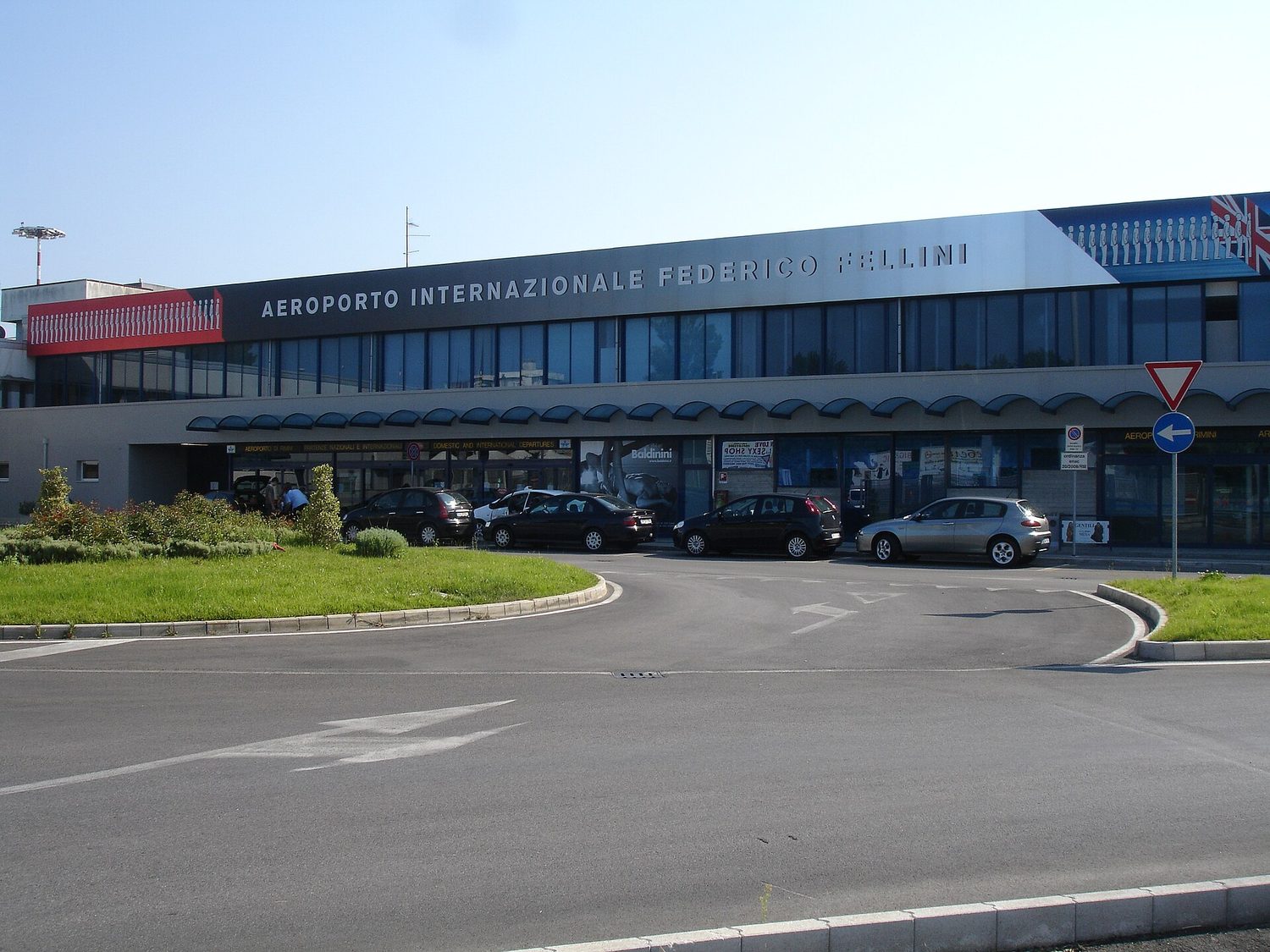
Federico Fellini International Airport
Rimini and San Marino "Federico Fellini" International Airport (Italian: Aeroporto Internazionale di Rimini e San Marino 'Federico Fellini'; IATA: RMI, ICAO: LIPR), formerly Rimini Miramare Airport (Italian: Aeroporto di Rimini Miramare), and more simply known as Rimini Airport or Fellini Airport, is an international airport located in Rimini, in the region of Emilia-Romagna, northern Italy. Fellini Airport is located in the southern frazione of Miramare, 5.2 kilometres (3.2 mi) southeast of Rimini's city centre and near Riccione. As well as serving the Province of Rimini, it is the main aerial gateway to the Republic of San Marino. The airport is a crucial nexus in the local economy, particularly for tourists visiting the riviera romagnola. Since the airport's reopening in 2014, following the bankruptcy of the previous management company, Fellini Airport has been managed by AIRiminum 2014 SpA. It is named after Italian filmmaker Federico Fellini, who was born in Rimini, and recorded 215,767 passengers in 2022, rendering it the second-busiest airport in Emilia-Romagna after Bologna Airport. The airport is mainly served by low-cost carriers and charter traffic. The airport was built in 1928 as an aerodrome, on the site of the former Rimini-Riccione Defence Section of the army's Aeronautical Service. It ranked among Italy's busiest airports during the 1960s, supported by international tourists visiting Rimini's beaches.
Location

44.020°N, 12.612°E · 12 m s. n. m. (40 ft)
General data
Runways · 1
Lengths and surfaces from the public OurAirports register; open runways only.
Radio frequencies · 3
Tower
Ground
Approach
Reference frequencies for enthusiasts, from OurAirports (community database, public domain), checked on Oct 16, 2026. They may be outdated or incomplete and do not replace the AIP or current charts: not for navigation. In Europe the published frequency may be an 8.33 kHz channel (e.g., 118.505 for 118.500). In MHz.
History
Early years
The site of the airport was used between July 1916 and November 1918 for the Rimini-Riccione Defence Section of the army's Aeronautical Service. The first airfield was constructed in 1929, with a single 500-metre (1,600-foot) dirt runway perpendicular to the coastline. An aviation club was established in the airfield soon after its opening. On 15 June 1929, the Office of Civil Aviation approved a thrice-weekly summer passenger service to Milan, operated by Avio Linee Italiane; the maiden flight landed in Rimini on 17 August. In 1931, the airfield was designated as a stopover on flights between Rome and London, and services began to Venice, Vienna, Munich, and Brindisi.
A military and aerostatic facility was developed at the airfield in the early 1930s, and became operational by 19 November 1937. On 28 March 1938, the airport was dedicated as a military airport and named after Giannetto Vassura, a Cotignolese pilot and Sergeant Major in the Italian Army who died on his first aerial deployment during the Battle of Vittorio Veneto in the First World War. The surrounding streets were named after Italian pilots, while a dancing bar opened for aviators outside the airport. Civil aviation continued, and from 20 July 1939, an overnight service allowed business travellers to return to Milan after a day on Rimini's beach.
The airport sustained heavy aerial bombardment in the Second World War, when it was used as a prisoner-of-war camp for captured Allied soldiers. During the Battle of Rimini, German forces defended the airport with Panther turrets, barring Allied forces from advancing further up the Gothic Line along the end of the Via Flaminia. The 3rd Greek Mountain Brigade and the 18th New Zealand Armoured Regiment engaged the airport, whose defence and capture was central to the Battle of Rimini. After its capture, it returned to its use as a prisoner-of-war camp, housing up to 80,000 Axis forces. The camp was lightly surveilled and both prostitution and escape were rife. Erich Priebke, a perpetrator of the Ardeatine massacre, was a notable escapee.
Military history
In July 1956, the airport became the home of the 5th Aerobrigade of the Italian Air Force. It soon became an important military base for the Cold War, employing up to 2,000 air force soldiers and several hundred NATO soldiers, who were housed in a special "blue village" accommodation inside the airport complex that was built in the 1960s. From 1964, as many as 18 Lockheed F-104G fighter-bombers were stationed at the airport. Until 1991, four underground bunkers at the base housed around thirty B61 nuclear bombs, later returned to the United States. The opening of state archives in Budapest revealed that the airport was identified by the Warsaw Pact as a sensitive target in the event of an all-out war. The airport was also the site of several pacifist protests.
Smaller military units began withdrawing from the airport in September 1993, at the conclusion of the Cold War. The military command bunker was dismantled in the 1990s. In September 2010, the 5th Aerobrigade completed its transfer to Cervia. Some military personnel remained to operate the control tower, radar service, and weather station; these were transferred to civilian control in November 2016. The control tower and weather station were transferred to ENAV, while the radar service came under the control of Bologna Avvicinamento. Helicopters belonging to the 7th Army Aviation Regiment "Vega" remained in Rimini.
In November 2022, it was reported that the remaining military sector of the airport would move upstream, where new hangars would be built to house the new 'Fenice' helicopter that would replace the current 'Mongusta' helicopter. In its place, the military sector would inaugurate an educational hub including a kindergarten and nursery school at the site of the former barracks. Staff accommodation would remain at their current site.
Aeradria
In 1958, after a campaign by senator Gino Zannini, the airport reopened to civilian traffic for fortnightly flights to London. The authorisation was granted on 23 February 1958 at a meeting in Rome between military and civil authorities and a delegation of Aero Club Rimini, led by aviator Tullio de Prato. In 1962, the management company Aeradria was founded. That year, Fellini Airport recorded 67,205 passengers on 1,120 flights. In 1966, Fellini Airport was Italy's fourth busiest airport by passenger numbers, with 392,594 passengers and 7,450 flights. Summer passenger movements exceeded annual movements in Turin Airport, explained in part by Italians' aversion to flying.
Prior to the opening of the A14 tolled highway in 1966, Fellini Airport was the main gateway to the riviera romagnola for foreign tourists, who constituted 60% of the tourism market. Fellini Airport would handle a hundred planes daily during the summer. The opening of the A14 reduced road journey times between Bologna and Rimini from eight hours to one, shifting the local tourist economy towards domestic tourism and reducing international demand from countries such as West Germany. The number of passengers peaked in 1972 with 558,000 passengers.
Airlines operating here · 11
Other airlines with direct routes
Airlines with current passenger routes from here, according to Wikipedia route tables cross-checked from both ends (October 2026).
Photo: Michele1978rimini · Public domain · view original
Data from OurAirports (public domain) · destinations and airlines from Wikipedia route tables (CC BY-SA, 2026), unless another source is given · profile and photo from Wikidata/Wikimedia Commons (CC0 / CC) · summary and history from Wikipedia (CC BY-SA).
Cite
To cite this page in academic work, an article or Wikipedia, choose the style and copy the reference. The access date is today.
This page was last updated on October 15, 2026
APA
Vuelopedia. (2026, October 15). Federico Fellini International Airport (RMI). Retrieved October 24, 2026, from https://vuelopedia.org/en/airport/RMI
MLA
“Federico Fellini International Airport (RMI).” Vuelopedia, Fundación Poderia, 15 Oct. 2026, vuelopedia.org/en/airport/RMI. Accessed 24 Oct. 2026.
Chicago
Vuelopedia. “Federico Fellini International Airport (RMI).” Fundación Poderia. Last modified October 15, 2026. https://vuelopedia.org/en/airport/RMI.
Harvard
Vuelopedia (2026) Federico Fellini International Airport (RMI). Available at: https://vuelopedia.org/en/airport/RMI (Accessed: 24 October 2026).
BibTeX
@misc{vuelopedia_en_airport_rmi,
  author       = {{Vuelopedia}},
  title        = {{Federico Fellini International Airport (RMI)}},
  publisher    = {Fundación Poderia},
  year         = {2026},
  date         = {2026-10-15},
  url          = {https://vuelopedia.org/en/airport/RMI},
  howpublished = {\url{https://vuelopedia.org/en/airport/RMI}},
  urldate      = {2026-10-24},
  note         = {Accessed 2026-10-24}
}Wikipedia
{{cite web |url=https://vuelopedia.org/en/airport/RMI |title=Federico Fellini International Airport (RMI) |website=Vuelopedia |publisher=Fundación Poderia |date=2026-10-15 |access-date=2026-10-24 |language=en}}