

Piarco International Airport
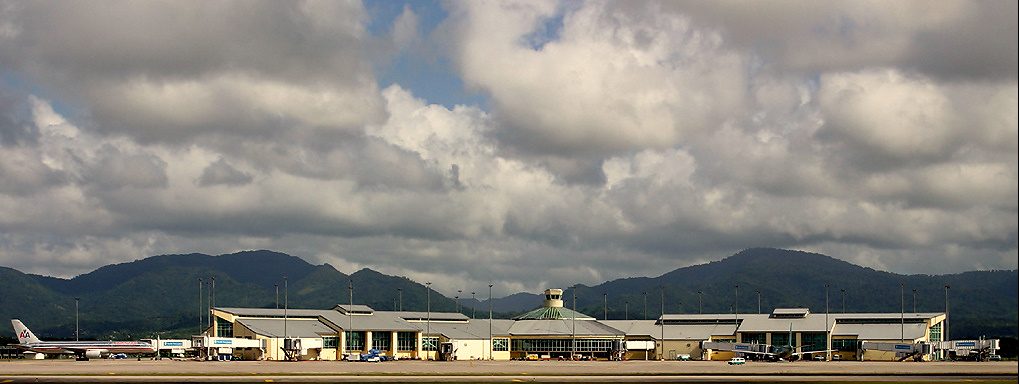
Piarco International Airport
Piarco International Airport (IATA: POS, ICAO: TTPP) is an international airport serving the island of Trinidad and is one of two international airports in Trinidad and Tobago. The airport is 30 km (19 mi) east of Downtown Port of Spain, in the suburban town of Piarco. The airport is the primary hub and operating base for the country's national airline, as well as the Caribbean's largest airline, Caribbean Airlines.
Location

10.595°N, 61.338°O · 18 m s. n. m. (58 ft)
General data
Runways · 1
Lengths and surfaces from the public OurAirports register; open runways only.
Radio frequencies · 5
Tower
Ground
ATIS (automatic information)
Approach
Area control (center)
Reference frequencies for enthusiasts, from OurAirports (community database, public domain), checked on Oct 16, 2026. They may be outdated or incomplete and do not replace the AIP or current charts: not for navigation. In Europe the published frequency may be an 8.33 kHz channel (e.g., 118.505 for 118.500). In MHz.
History
The Piarco Airport opened on 8 January 1931, to serve Venezuela's Compagnie Générale Aéropostale. Before this, the Queen's Park Savannah, the Mucurapo Field, and the Cocorite Docks (for flying boats) were used as airstrips to serve the island.
World War II
During World War II, the initial airfield served the Royal Navy as the base for the Fleet Air Arm’s No. 1 Observer Training School. Referred to as Royal Naval Air Station Piarco (RNAS Piarco), it opened on 1 August 1940 and later commissioned as HMS Goshawk on 6 November. The squadrons listed below were stationed there until their disbandment during October 1945. HMS Goshawk was decommissioned on 28 February 1946 RNAS Piarco closed on the same day:
Squadrons at HMS Goshawk
List of Fleet Air Arm first and second line squadrons, station flight and other flying units either based at or disembarked to RNAS Piarco (HMS Goshawk):
Based squadrons
749 Naval Air Squadron, an Observer Training Squadron, was a component of the No.1 Observer School. Established on 1 January 1941, it ceased operations on 1 October 1945. It was quipped with the amphibious aircraft the Supermarine Walrus and the Grumman Goose along with Avro Anson multirole training aircraft.
750 Naval Air Squadron, an Observer Training Squadron, was also a component of Royal Navy’s No.1 Observer School. It arrived at the station on 5 November 1940 following relocation from the UK. The squadron disbanded on 10 October 1945. It was equipped with the torpedo bombers Blackburn Shark and Fairey Albacore, and the torpedo/dive bomber Fairey Barracuda.
752 Naval Air Squadron was an Observer Training Squadron and also a component of the No.1 Observer School of the Royal Navy. The squadron arrived at the station on 5 November 1940 after being relocated from the UK. It disbanded on 9 October 1945. It was equipped with Percival Proctor radio trainer/communications aircraft, de Havilland Tiger Moth training aircraft and Fairey Albacore torpedo bomber,
793 Naval Air Squadron, an Air Towed Target Unit, a component of No.1 Observer School. It arrived at the station on 18 November 1940 after being relocated from the UK. It disbanded on 10 October 1945. It was equipped with the fighter aircraft Blackburn Roc, Miles Martinet T.T.1 target tug, Fairey Fulmar fighter/reconnaissance aircraft and Fairey Albacore.
Disembarked squadron
'Z' Flight 817 Naval Air Squadron, a Torpedo, Spotter, Reconnaissance Squadron. Consisting of Fairey Albacore, it arrived here from the RN Air Section at USNAS Norfolk, Virginia on 21 September 1943. Aircraft were withdrawn and re-issued to 750 Squadron. Personnel departed for USNAS Norfolk on 27 September 1943.
USAAF
In 1942 it was also used by both the United States Army Air Forces Sixth Air Force and United States Navy air squadrons. The airport was used both as a transport airfield and also for anti submarine patrol flights over the south Caribbean.
In World War II the United States Army Air Forces Sixth Air Force stationed the following units at the airport performing anti submarine patrols:
1st Bombardment Squadron (9th Bombardment Group) 24 April – 29 October 1941 (B-18 Bolo)
10th Bombardment Squadron (25th Bombardment Group) 27 August – 12 October 1943 (B-18 Bolo)
35th Bombardment Squadron (25th Bombardment Group) 27 August – 12 October 1943 (B-18 Bolo)
It was returned to civil control after the war ended.
Airlines operating here · 13
Airlines using it as a main base (hub)
Other airlines with direct routes
Airlines with current passenger routes from here, according to Wikipedia route tables cross-checked from both ends (October 2026).
Photo: Saltprune416 · CC BY-SA 3.0 · view original
Data from OurAirports (public domain) · destinations and airlines from Wikipedia route tables (CC BY-SA, 2026), unless another source is given · profile and photo from Wikidata/Wikimedia Commons (CC0 / CC) · summary and history from Wikipedia (CC BY-SA).
Cite
To cite this page in academic work, an article or Wikipedia, choose the style and copy the reference. The access date is today.
This page was last updated on October 15, 2026
APA
Vuelopedia. (2026, October 15). Piarco International Airport (POS). Retrieved October 17, 2026, from https://vuelopedia.org/en/airport/POS
MLA
“Piarco International Airport (POS).” Vuelopedia, Fundación Poderia, 15 Oct. 2026, vuelopedia.org/en/airport/POS. Accessed 17 Oct. 2026.
Chicago
Vuelopedia. “Piarco International Airport (POS).” Fundación Poderia. Last modified October 15, 2026. https://vuelopedia.org/en/airport/POS.
Harvard
Vuelopedia (2026) Piarco International Airport (POS). Available at: https://vuelopedia.org/en/airport/POS (Accessed: 17 October 2026).
BibTeX
@misc{vuelopedia_en_airport_pos,
  author       = {{Vuelopedia}},
  title        = {{Piarco International Airport (POS)}},
  publisher    = {Fundación Poderia},
  year         = {2026},
  date         = {2026-10-15},
  url          = {https://vuelopedia.org/en/airport/POS},
  howpublished = {\url{https://vuelopedia.org/en/airport/POS}},
  urldate      = {2026-10-17},
  note         = {Accessed 2026-10-17}
}Wikipedia
{{cite web |url=https://vuelopedia.org/en/airport/POS |title=Piarco International Airport (POS) |website=Vuelopedia |publisher=Fundación Poderia |date=2026-10-15 |access-date=2026-10-17 |language=en}}