

Ninoy Aquino International Airport
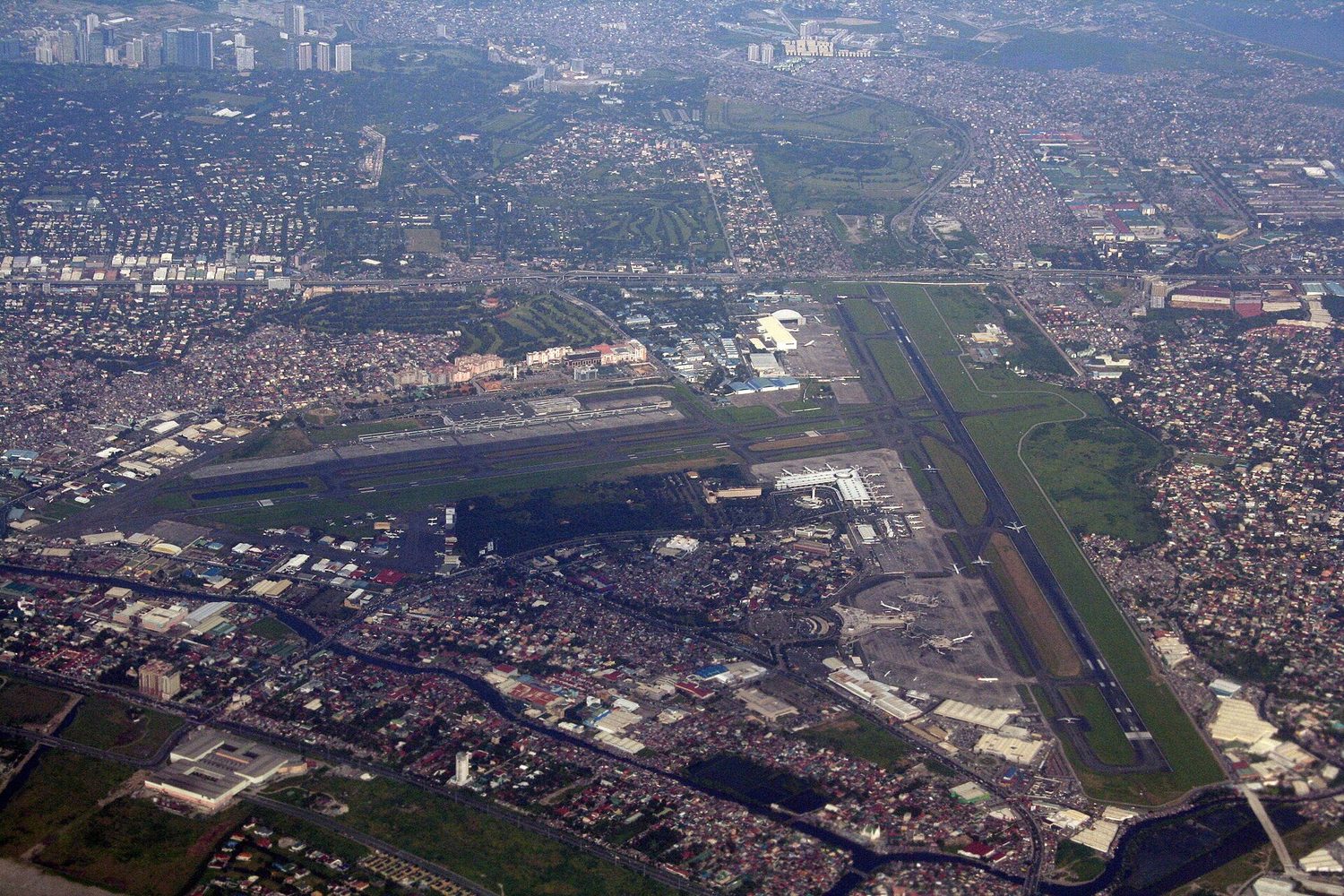
Ninoy Aquino International Airport
Ninoy Aquino International Airport (NAIA NAH-EE-?; Filipino: Paliparang Pandaigdig ng Ninoy Aquino; IATA: MNL, ICAO: RPLL), also known as Manila Airport or Manila International Airport (MIA), is the main international airport serving Metro Manila in the Philippines. Located between the cities of Pasay and Parañaque, about 7 kilometers (4.3 mi) south of Manila proper and southwest of Makati, it is the main gateway for travelers to the Philippines. It serves as a hub for Philippine Airlines and its regional subsidiary PAL Express. It is also the main operating base for Cebu Pacific, and Philippines AirAsia. Opened in 1948, the airport was officially renamed for former Philippine senator Benigno "Ninoy" Aquino Jr., who was assassinated at the airport on August 21, 1983. NAIA is managed by the Manila International Airport Authority (MIAA), an agency of the Department of Transportation (DOTr). It is currently operated by the New NAIA Infrastructure Corporation (NNIC), a private consortium of companies led by San Miguel Corporation. In 2024, NAIA served more than 50 million passengers, 47% more than the previous year and an all-time record high, making it the busiest airport in the Philippines, the 17th busiest in Asia, and the 38th busiest in the world. The airport is operating beyond its designed capacity of 35 million passengers, clogging air traffic and delaying flights. As a result, it has consistently been cited as one of the world's worst airports.
Location

14.509°N, 121.020°E · 23 m s. n. m. (75 ft)
General data
Runways · 2
Lengths and surfaces from the public OurAirports register; open runways only.
Radio frequencies · 7
Tower
Ground
Clearance delivery
ATIS (automatic information)
Approach
Area control (center)
Apron
Reference frequencies for enthusiasts, from OurAirports (community database, public domain), checked on Oct 16, 2026. They may be outdated or incomplete and do not replace the AIP or current charts: not for navigation. In Europe the published frequency may be an 8.33 kHz channel (e.g., 118.505 for 118.500). In MHz.
History
Manila's original airport, Grace Park Airfield (also known as Manila North) in Grace Park, Caloocan (then a municipality of Rizal), opened in 1935. It was the city's first commercial airport and was used by the Philippine Aerial Taxi Company (later Philippine Airlines) for its first domestic routes. In July 1937, Nielson Airport, located in the 45-hectare (4,800,000 ft2) land in Makati, also then in Rizal, was inaugurated and served as the gateway to Manila; its runways now form Ayala Avenue and Paseo de Roxas. Following World War II and Philippine independence, Grace Park Airfield ceased operations, while Nielson Airport continued to operate until it was decommissioned in 1948. Airport operations were moved to the current site, Nichols Field, due to the flatter terrain, expanse of greenfield land, and the existing USAF base runway (Runway 13/31), which could be used for the airport. The original one-story bungalow terminal was built adjacent to the runway and served as Terminal 4. In 1954, the airport's longer international runway (Runway 06/24) and associated taxiways were built, and in 1956, construction was started on a control tower and an international terminal building. The new terminal was designed by Federico Ilustre and was built on the current site of Terminal 2. It was inaugurated on September 22, 1961. On August 5, 1960, Pan Am inaugurated the first scheduled jet aircraft services to Manila with the arrival of a Boeing 707 from Hong Kong. On December 4, 1970, the airport welcomed its first widebody aircraft, a Boeing 747-100 of Northwest Orient Airlines. On January 22, 1972, a fire caused substantial damage to the terminal, resulting in six casualties. A slightly smaller terminal was built the following year. This second terminal would serve as the country's international terminal until 1981 when it was converted to a domestic terminal, upon the completion and opening of Terminal 1, a new, higher-capacity terminal. Another fire damaged the old international terminal in May 1985. The development of the Manila International Airport, which includes Terminal 1, was approved by Executive Order No. 381 immediately after the former airport was destroyed by a fire a month earlier. The project's feasibility study and master plan were conducted by the Airways Engineering Corporation in 1973, supported by a US$29.6 million loan from the Asian Development Bank (ADB). In 1974, the designs were approved by the Philippine government and the ADB. Construction began in the second quarter of 1978 on a site close to the original Manila Airport, within the jurisdiction of Parañaque, then a municipality of Metro Manila. On August 21, 1983, oppositionist politician Ninoy Aquino attempted to return to the Philippines from exile in the United States, hoping to convince president Ferdinand Marcos to let go of political power after having held his position for nearly two decades. Aquino was assassinated mere moments after exiting his plane at Terminal 1's Gate 8. Aviation Security Command (AVSECOM) personnel escorted Aquino out of the plane to the tarmac, where an agency van awaited. A single gunshot was fired, identified as the one that killed him, with several more shots following, killing the alleged assassin, Rolando Galman. Seconds later, gunfire erupted, causing chaos in the plane, the tarmac, and the terminal. The incident triggered constant protests for the next three years, and along with the crash of the Philippine economy earlier in 1983, is credited as one of the key events which led to the People Power Revolution in 1986 which removed Marcos from power. Four years after the incident, during the presidency of Ninoy's widow Corazon Aquino in 1987, Republic Act No. 6639 was enacted without executive approval, renaming the airport in Ninoy's honor.
Airlines operating here · 51
Other airlines with direct routes
List taken from the airport’s own website (September 2026).
Photo: Josh Lim (Sky Harbor) · CC BY-SA 4.0 · view original
Data from OurAirports (public domain) · destinations and airlines from Wikipedia route tables (CC BY-SA, 2026), unless another source is given · profile and photo from Wikidata/Wikimedia Commons (CC0 / CC) · summary and history from Wikipedia (CC BY-SA).
Cite
To cite this page in academic work, an article or Wikipedia, choose the style and copy the reference. The access date is today.
This page was last updated on October 15, 2026
APA
Vuelopedia. (2026, October 15). Ninoy Aquino International Airport (MNL). Retrieved October 16, 2026, from https://vuelopedia.org/en/airport/MNL
MLA
“Ninoy Aquino International Airport (MNL).” Vuelopedia, Fundación Poderia, 15 Oct. 2026, vuelopedia.org/en/airport/MNL. Accessed 16 Oct. 2026.
Chicago
Vuelopedia. “Ninoy Aquino International Airport (MNL).” Fundación Poderia. Last modified October 15, 2026. https://vuelopedia.org/en/airport/MNL.
Harvard
Vuelopedia (2026) Ninoy Aquino International Airport (MNL). Available at: https://vuelopedia.org/en/airport/MNL (Accessed: 16 October 2026).
BibTeX
@misc{vuelopedia_en_airport_mnl,
  author       = {{Vuelopedia}},
  title        = {{Ninoy Aquino International Airport (MNL)}},
  publisher    = {Fundación Poderia},
  year         = {2026},
  date         = {2026-10-15},
  url          = {https://vuelopedia.org/en/airport/MNL},
  howpublished = {\url{https://vuelopedia.org/en/airport/MNL}},
  urldate      = {2026-10-16},
  note         = {Accessed 2026-10-16}
}Wikipedia
{{cite web |url=https://vuelopedia.org/en/airport/MNL |title=Ninoy Aquino International Airport (MNL) |website=Vuelopedia |publisher=Fundación Poderia |date=2026-10-15 |access-date=2026-10-16 |language=en}}