

McKellar-Sipes Regional Airport
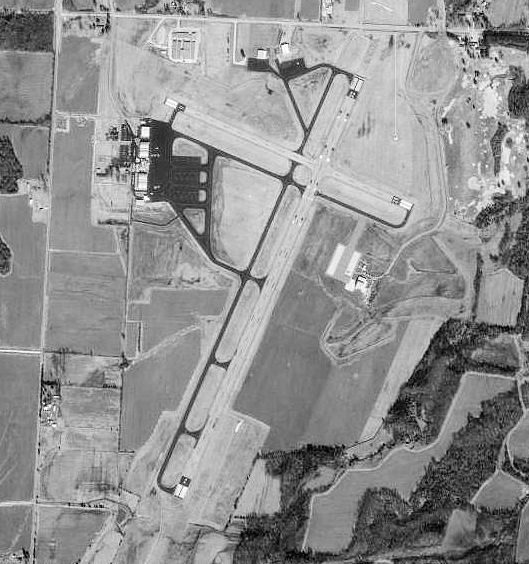
McKellar-Sipes Regional Airport
Jackson Regional Airport (IATA: MKL, ICAO: KMKL, FAA LID: MKL) (formerly McKellar-Sipes Regional Airport) is a public use airport located four nautical miles (7 km) west of the central business district of Jackson, a city in Madison County, Tennessee, United States. It is owned by the city and county. The airport is mostly used for general aviation, and is served by one commercial airline, Denver Air Connection, subsidized by the Essential Air Service program. Denver Air Connection operates six days a week, offering round-trip services to Chicago, Illinois via O'Hare International Airport and Atlanta, Georgia via Hartsfield–Jackson Atlanta International Airport. The National Plan of Integrated Airport Systems for 2021–2025 categorized it as a non-primary commercial service airport.
Location

35.600°N, 88.916°O · 132 m s. n. m. (434 ft)
General data
Runways · 2
Lengths and surfaces from the public OurAirports register; open runways only.
Radio frequencies · 5 Official publication
Tower
Ground
Approach
UNICOM
Automated weather
Frequencies from the official publication: FAA NASR, AIRAC 01 OCT 2026, checked on Oct 16, 2026. They change with each amendment: not for navigation without checking the current AIP. See the official publication In MHz.
History
The airport was established by and originally named in memory of Kenneth Douglas McKellar (1869–1957), a longtime U.S. senator from Tennessee. He helped to convince the Civil Works Administration to acquire the property and construct the initial runways and buildings during the winter of 1933–1934. Later in the 1930s, the Works Project Administration (WPA) expanded the airport and constructed additional buildings and other facilities.
McKellar Field
In preparation for the eventual U.S. entry into World War II, the United States Army Air Corps sought to expand the nation's combat air forces by asking civilian flight schools to provide the primary phase of training for air cadets. Consequently, it contracted with civilian flying schools to provide primary flying training, with the graduates being moved on to basic and advanced training at regular military training airfields.
In April 1942 the airport was leased by the United States Army Air Forces and became a wartime flight training school. McKellar Field was assigned to the Southeast Training Center (later the Eastern Flying Training Command) as a primary (level 1) pilot training airfield. It was under the command of the 68th Flying Training Detachment, 29th Flying Training Wing. The airfield began training flying cadets under contract to Georgia Air Services, Inc. Flying training was performed with PT-17 Stearman biplanes as the primary trainer. It also had several Fairchild PT-19, Ryan PT-22 Recruits and PT-27 Kaydets assigned.
The physical facilities of McKellar Field included administrative buildings and quarters for officers and enlisted men, encircling a central location. A consolidated mess hall, which accommodated 1,000 enlisted men and a limited number of' officers, was located nearby. Adjacent to the mess hall was a Post Exchange, a Service Club and a dance floor.
The facility was inactivated on October 16, 1944 with the drawdown of AAFTC's pilot training program. It was declared surplus and turned over to the Army Corps of Engineers on September 30, 1945. Eventually it was discharged to the War Assets Administration (WAA) and became a civil airport.
Jackson Regional Airport
After the war, the airport reverted to the control of the city and county, and was expanded over the years with new facilities to accommodate the needs of Jackson and Madison County. Nearly all of the wartime buildings erected at the airport were torn down or moved, although four of the wartime hangars remain in use at the airport. A few of the streets from McKellar Field remain visible in aerial photography but other than some isolated concrete remaining, the station area has been totally removed.
A military presence remains at the airport, with the Tennessee Army National Guard's 1/230th Air Cavalry Squadron having an extensive support facility at the airport, equipped with UH-60 Blackhawk helicopters.
In the 1970s, the airport name was changed to McKellar–Sipes Regional Airport to honor Major Robert Ray "Buster" Sipes, a United States Air Force test pilot from Jackson, who was killed in 1969 when his RF-101 Voodoo jet fighter crashed after takeoff from RAF Upper Heyford, Oxfordshire, England. A plaque is located in the Church of St. Peter & St. Paul at Steeple Aston to honor his memory. Sipes is buried at the Shiloh National Military Park cemetery.
The airport was renamed again in December, 2024 to Jackson Regional Airport as part of a marketing plan focused on improving the airport's visibility in its market area.
Airlines operating here · 1
Other airlines with direct routes
Airlines with current passenger routes from here, according to Wikipedia route tables cross-checked from both ends (October 2026).
Photo: United States Geological Survey (USGS) · Public domain · view original
Data from OurAirports (public domain) · destinations and airlines from Wikipedia route tables (CC BY-SA, 2026), unless another source is given · profile and photo from Wikidata/Wikimedia Commons (CC0 / CC) · summary and history from Wikipedia (CC BY-SA).
Cite
To cite this page in academic work, an article or Wikipedia, choose the style and copy the reference. The access date is today.
This page was last updated on October 16, 2026
APA
Vuelopedia. (2026, October 16). McKellar-Sipes Regional Airport (MKL). Retrieved October 23, 2026, from https://vuelopedia.org/en/airport/MKL
MLA
“McKellar-Sipes Regional Airport (MKL).” Vuelopedia, Fundación Poderia, 16 Oct. 2026, vuelopedia.org/en/airport/MKL. Accessed 23 Oct. 2026.
Chicago
Vuelopedia. “McKellar-Sipes Regional Airport (MKL).” Fundación Poderia. Last modified October 16, 2026. https://vuelopedia.org/en/airport/MKL.
Harvard
Vuelopedia (2026) McKellar-Sipes Regional Airport (MKL). Available at: https://vuelopedia.org/en/airport/MKL (Accessed: 23 October 2026).
BibTeX
@misc{vuelopedia_en_airport_mkl,
  author       = {{Vuelopedia}},
  title        = {{McKellar-Sipes Regional Airport (MKL)}},
  publisher    = {Fundación Poderia},
  year         = {2026},
  date         = {2026-10-16},
  url          = {https://vuelopedia.org/en/airport/MKL},
  howpublished = {\url{https://vuelopedia.org/en/airport/MKL}},
  urldate      = {2026-10-23},
  note         = {Accessed 2026-10-23}
}Wikipedia
{{cite web |url=https://vuelopedia.org/en/airport/MKL |title=McKellar-Sipes Regional Airport (MKL) |website=Vuelopedia |publisher=Fundación Poderia |date=2026-10-16 |access-date=2026-10-23 |language=en}}