

Laoag International Airport
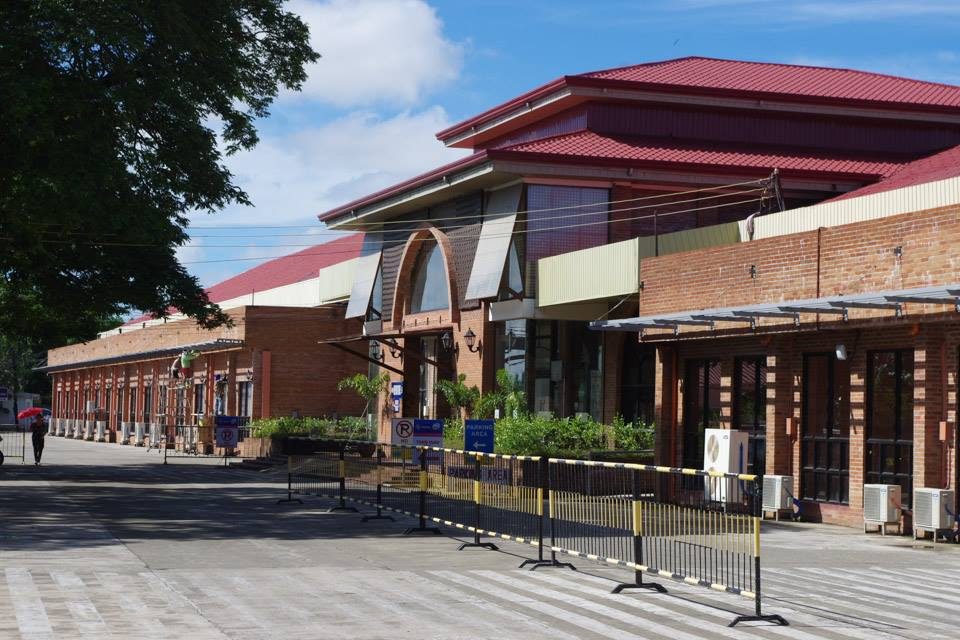
Laoag International Airport
Laoag International Airport (IATA: LAO, ICAO: RPLI) is an airport serving the general area of Laoag, the capital city of the province of Ilocos Norte in the Philippines. It is the only airport in Ilocos Norte and is the northernmost international airport in the Philippines. The land on which the airport sits today is located near the La Paz Sand Dunes at the mouth of the Padsan River. It has one 2,784-meter runway and is designated as a secondary/alternate international airport by the Civil Aviation Authority of the Philippines, a body of the Department of Transportation responsible for the operations of not only this airport but also of all other airports in the Philippines except the major international airports.
Location

18.175°N, 120.531°E · 8 m s. n. m. (25 ft)
General data
Runways · 1
Lengths and surfaces from the public OurAirports register; open runways only.
Radio frequencies · 3
Tower
Approach
Flight information
Reference frequencies for enthusiasts, from OurAirports (community database, public domain), checked on Oct 16, 2026. They may be outdated or incomplete and do not replace the AIP or current charts: not for navigation. In Europe the published frequency may be an 8.33 kHz channel (e.g., 118.505 for 118.500). In MHz.
History
Early history
During the American colonial period, a military airfield located in the northern part of Luzon became imperative. Laoag, the most populated settlement at the time was chosen as the site. It became known as Gabu Airfield.
World War II
During the initial invasion of the Japanese in the Philippines in December 1941, Gabu Airfield was captured and subsequently used. During the Luzon campaign to retake the islands from the Japanese, Major Simeon Valdez led a raid on the airfield, burning the headquarters and setting fire to a fuel dump. Similar attacks follow in the succeeding days until its abandonment on February 15, 1945 due to Commonwealth military and guerrilla raids. It was then recaptured on February 27, 1945.
By April 1945 the airfield was again operational hosting fighter and transport aircraft. Colonel Arvid E. Olson, Jr. became the Base Commander and assumed all its administrative functions. The airfield became a staging area for flights and air missions against Japanese forces in Northern Luzon by April and became an important refueling point for planes en route to Okinawa and an even more important emergency and rescue base for planes returning from Formosa and China.
Contemporary history
After the war, the airfield was converted into a civilian airport. It mostly catered to domestic flights from Manila and international flights from nearby countries of China, Hong Kong and Singapore and as far as Honolulu, Hawaii.
In 2003, the airport was an epicenter of concern for authorities during the 2002–2004 SARS outbreak during which it continued to receive flights from China and Singapore, two of the most affected countries.
The airport became one of the stops of the Breitling DC-3 World Tour held in April 2017. The aircraft, a Douglas DC-3 with the registration number HB-IRJ landed for refueling as part of a round-the-world flight to celebrate the plane's 77th birthday.
The airport was also where 4 FA-50 light fighter aircraft were stored during the testing of Israeli radars on Paredes Air Station in Pasuquin, Ilocos Norte. There are plans to store FA-50s on the airport as a warning squadron for any disaster/threat to the northern part of the Philippines.
The terminal building's ceiling and floor were damaged by the onslaught of Typhoon Doksuri (Egay) in Northern Luzon in July 2023.
Airlines operating here · 3
Other airlines with direct routes
Airlines with current passenger routes from here, according to Wikipedia route tables cross-checked from both ends (October 2026).
Photo: Alaric A. Yanos · Public domain · view original
Data from OurAirports (public domain) · destinations and airlines from Wikipedia route tables (CC BY-SA, 2026), unless another source is given · profile and photo from Wikidata/Wikimedia Commons (CC0 / CC) · summary and history from Wikipedia (CC BY-SA).
Cite
To cite this page in academic work, an article or Wikipedia, choose the style and copy the reference. The access date is today.
This page was last updated on October 15, 2026
APA
Vuelopedia. (2026, October 15). Laoag International Airport (LAO). Retrieved October 25, 2026, from https://vuelopedia.org/en/airport/LAO
MLA
“Laoag International Airport (LAO).” Vuelopedia, Fundación Poderia, 15 Oct. 2026, vuelopedia.org/en/airport/LAO. Accessed 25 Oct. 2026.
Chicago
Vuelopedia. “Laoag International Airport (LAO).” Fundación Poderia. Last modified October 15, 2026. https://vuelopedia.org/en/airport/LAO.
Harvard
Vuelopedia (2026) Laoag International Airport (LAO). Available at: https://vuelopedia.org/en/airport/LAO (Accessed: 25 October 2026).
BibTeX
@misc{vuelopedia_en_airport_lao,
  author       = {{Vuelopedia}},
  title        = {{Laoag International Airport (LAO)}},
  publisher    = {Fundación Poderia},
  year         = {2026},
  date         = {2026-10-15},
  url          = {https://vuelopedia.org/en/airport/LAO},
  howpublished = {\url{https://vuelopedia.org/en/airport/LAO}},
  urldate      = {2026-10-25},
  note         = {Accessed 2026-10-25}
}Wikipedia
{{cite web |url=https://vuelopedia.org/en/airport/LAO |title=Laoag International Airport (LAO) |website=Vuelopedia |publisher=Fundación Poderia |date=2026-10-15 |access-date=2026-10-25 |language=en}}