

Adisutjipto International Airport
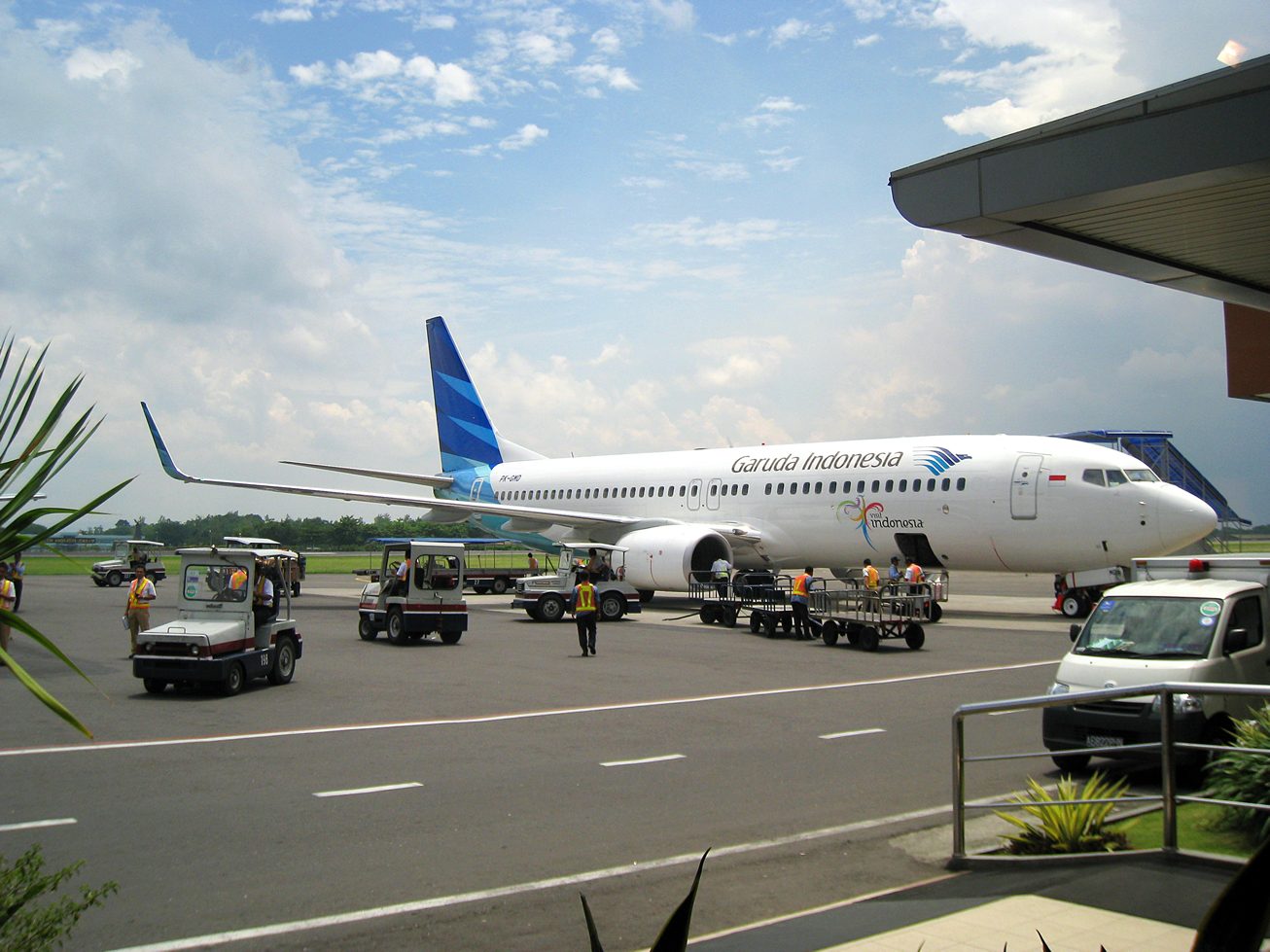
Adisutjipto International Airport
Adisutjipto Airport (IATA: JOG, ICAO: WAHH) is a domestic airport serving Yogyakarta, the capital city of the Special Region of Yogyakarta, and its surrounding areas on the island of Java, Indonesia. The airport is named after Agustinus Adisutcipto, an Indonesian Air Force officer and a recognized National Hero of Indonesia. Although it primarily serves the city, the airport is located in Maguwoharjo, Sleman Regency, on the northeastern outskirts of Yogyakarta, near the Prambanan temple complex and close to the border with Klaten Regency in Central Java. The airport lies approximately 6 kilometres (3.7 mi) from the city centre. Prior to the opening of Yogyakarta International Airport in Kulon Progo Regency in 2019, Adisutjipto Airport was the main gateway to Yogyakarta, handling domestic flights to major cities such as Jakarta, Denpasar, and Surabaya, as well as international services to Singapore and Malaysia. At its peak, it was the fourth busiest airport in the Java–Bali region, after Soekarno–Hatta International Airport in Jakarta, Juanda International Airport in Surabaya, and Ngurah Rai International Airport in Bali. Following the opening of the new airport, Adisutjipto now functions as a secondary airport, serving limited short-haul domestic routes, primarily to Jakarta. While the commercial operations of the airport are managed by InJourney Airports, the land itself is owned by the Indonesian Air Force, with the passenger terminal functioning as a civil enclave.
Location

7.788°S, 110.432°E · 116 m s. n. m. (379 ft)
General data
History
World War II
Adisutjipto Airport traces its origins to a landing ground at Maguwo, constructed by the Dutch East Indies colonial government in 1940 as a military airbase for the Royal Netherlands East Indies Army Air Force (ML-KNIL). With the outbreak of World War II and the onset of the Pacific War, Maguwo Airfield became the home base of Verkenningsafdeling 2 (2nd Cooperation Squadron) of the ML-KNIL. The unit operated 11 Curtiss-Wright CW-22 aircraft and 2 Fokker C.X aircraft, and was placed under the control of ML-KNIL headquarters to carry out battlefield aerial reconnaissance missions.
Japanese forces launched their invasion of the Dutch East Indies in January 1942 and had landed on Java by the end of the following month. Amid the Japanese advance, Maguwo Airfield became the last remaining operational airfield in Java available to Allied forces. At the time, a small number of United States Army Air Forces (USAAF) aircraft from the Fifth Air Force were stationed at Maguwo Airfield. By early March, as Japanese forces advanced to within 20 miles of the airfield, the aircraft were withdrawn to Broome, Australia. The remaining airmen subsequently evacuated, effectively abandoning the facility. Meanwhile, Dutch soldiers sabotaged the runway to prevent it from being captured in operational condition, before proceeding to destroy remaining ammunition. The Japanese soon captured the airfield intact and promptly restored it for their own use, employing captured Allied prisoners of war to repair bomb craters and damaged buildings.
During the Japanese occupation, the airfield was operated by the Imperial Japanese Navy Air Service. Throughout the war, the Japanese constructed various fortifications around the site, including underground bunkers, some of which remain to this day. By 1945, the airfield had become the base of the Navy's 31st Air Group, which operated around eighty Yokosuka K5Y biplanes used to train pilots for kamikaze missions against Allied forces.
Indonesian National Revolution
Following the surrender of Japan in August 1945, Japanese troops at the airfield laid down their arms to the British Army. Despite this, they were permitted to continue guarding Maguwo Airfield under the supervision of a British non-commissioned officer. On 2 October 1945, Indonesian militias launched an attack on the airfield, prompting the Japanese to surrender and hand over their equipment, largely intact, to the local forces. At that time, Maguwo Airfield possessed around 70 ex-Japanese aircraft. In the second week of October 1945, following the capture of the airbase, initial efforts focused on regrouping Indonesian aviation personnel. Approximately 30 individuals were assembled, forming the first team responsible for carrying out aircraft repairs. On 27 October 1945, the first repaired aircraft took to the air—a Yokosuka K5Y, nicknamed “Cureng”, flown by Agustinus Adisutjipto, a former ML-KNIL pilot. On 15 November 1945, a flight school was established at the airfield, with Agustinus Adisutjipto serving as its principal. This institution later became the precursor to the present-day Indonesian Air Force Academy.
Throughout the Indonesian National Revolution, Maguwo Airfield served as a major base of the Indonesian Air Force. The Dutch, recognizing the strategic importance of the airfield, repeatedly targeted it throughout the conflict. When the Dutch launched Operation Product in July 1947, they destroyed most of the former Japanese aircraft at Maguwo Airfield, leaving only a few intact and severely weakening the Indonesian Air Force. On 29 July 1947, two Dutch Curtiss P-40 Kittyhawks shot down a Douglas C-47 Skytrain that was approaching Maguwo Airfield while carrying medical supplies from Malaya. Among those on board were several Indonesian figures, including Agustinus Adisutjipto and the prominent aviator Abdul Rahman Saleh; only one person survived.
The Dutch launched a second major offensive against the Republic in December 1948, codenamed Operation Kraai, with the capture of Yogyakarta as its primary objective. Securing Maguwo Airfield was a key initial step in the operation. In the early hours of 19 December 1948, Dutch aircraft took off from Bandung and approached Yogyakarta via the Indian Ocean. At around 05:30, the ML-KNIL bombed Maguwo Airfield and nearby communications facilities. Shortly afterward, Dutch paratroopers from the Korps Speciale Troepen landed at the airfield, which was defended by just 47 lightly armed Indonesian Air Force cadets with no anti-aircraft weapons. The ensuing engagement lasted about 25 minutes and ended with the Dutch capturing the airfield. Around 128 Indonesian defenders were killed, while the Dutch reportedly suffered no casualties. By 06:45, after securing the perimeter, Dutch forces landed additional troops in two successive waves and established Maguwo as an airhead for reinforcements from their main base in Semarang.
Airlines operating here · 3
Other airlines with direct routes
Airlines with current passenger routes from here, according to Wikipedia route tables cross-checked from both ends (October 2026).
Photo: Gunawan Kartapranata · CC BY-SA 3.0 · view original
Data from OurAirports (public domain) · destinations and airlines from Wikipedia route tables (CC BY-SA, 2026), unless another source is given · profile and photo from Wikidata/Wikimedia Commons (CC0 / CC) · summary and history from Wikipedia (CC BY-SA).
Cite
To cite this page in academic work, an article or Wikipedia, choose the style and copy the reference. The access date is today.
This page was last updated on October 15, 2026
APA
Vuelopedia. (2026, October 15). Adisutjipto International Airport (JOG). Retrieved October 16, 2026, from https://vuelopedia.org/en/airport/JOG
MLA
“Adisutjipto International Airport (JOG).” Vuelopedia, Fundación Poderia, 15 Oct. 2026, vuelopedia.org/en/airport/JOG. Accessed 16 Oct. 2026.
Chicago
Vuelopedia. “Adisutjipto International Airport (JOG).” Fundación Poderia. Last modified October 15, 2026. https://vuelopedia.org/en/airport/JOG.
Harvard
Vuelopedia (2026) Adisutjipto International Airport (JOG). Available at: https://vuelopedia.org/en/airport/JOG (Accessed: 16 October 2026).
BibTeX
@misc{vuelopedia_en_airport_jog,
  author       = {{Vuelopedia}},
  title        = {{Adisutjipto International Airport (JOG)}},
  publisher    = {Fundación Poderia},
  year         = {2026},
  date         = {2026-10-15},
  url          = {https://vuelopedia.org/en/airport/JOG},
  howpublished = {\url{https://vuelopedia.org/en/airport/JOG}},
  urldate      = {2026-10-16},
  note         = {Accessed 2026-10-16}
}Wikipedia
{{cite web |url=https://vuelopedia.org/en/airport/JOG |title=Adisutjipto International Airport (JOG) |website=Vuelopedia |publisher=Fundación Poderia |date=2026-10-15 |access-date=2026-10-16 |language=en}}